MCQ
Transition metals are less reactive because of their:
  • A
    High ionization potential and low melting point.
  • High ionization potential and high melting point.
  • C
    Low ionization potential and low melting point.
  • D
    Low ionization potential and high melting point.

Answer

Correct option: B.
High ionization potential and high melting point.
Transition metals are less reactive relative to $I$ and $II$ group due to higher ionization potential and high melting point $($due to greater no of bonding electrons$).$

Need a full question paper?

Generate a complete, print-ready paper with questions like this in minutes — across 16+ boards, with answer keys.

Start Generating Free

Similar questions

Columns $1,2 and 3$ contain starting materials, reaction conditions, and type of reactions, respectively.

$column 1$ $column 2$ $column 3$
$(I)$ Toluene $(i)$ $\mathrm{NaOH} / \mathrm{Br}_2$ $(P)$ Condensation
$(II)$ Acetophenone $(ii)$ $\mathrm{Br}_2 / \mathrm{h} v$ $(Q)$ Carboxylation
$(III)$ Benzaldehyde $(iii)$ $\left(\mathrm{CH}_3 \mathrm{CO}\right)_2 \mathrm{O} / \mathrm{CH}_3 \mathrm{COOK}$ $(R)$ Substion
$(IV)$ Phenol $(iv)$ $\mathrm{NaOH} / \mathrm{CO}_2$ $(S)$ Haloform

($1$) For the synthesis of benzoic acid, the only $CORRECT$ combination is

$[A] (III) (iv) (R)$   $[B] (IV)(ii) (P)$   $[C] (I) (iv) (Q)$   $[D] (II) (i) (S)$

($2$)  The only CORRECT combination in which the reaction proceeds through radical mechanism is

$[A] (I)$ $(ii) (R)$     $[B] (II) (iii) (R)$     $[C] (III) (ii) (P)$    $[D] (IV) (i) (Q)$

($3$) The only CORRECT combination that gives two different carboxylic acids is

$[A] (IV) (iii) (Q)$ $[B] (III) (iii) (P)$ $[C] (II) (iv) (R)$ $[D] (I) (i) (S)$

Given the answer quetion ($1$) ($2$) and ($3$)
Teflon is most commonly used in:
$........$ are used to control body temperature during fever.
In the preparation of chlorine from $HCl,$ $Mn{O_2}$ acts as
Acetaldehyde and acetone can be distinguished by
$0.5\,M$  of ${H_2}S{O_4}$ is diluted from $1\,litre$ to $10\,litre$, normality of resulting solution is ......... $N$.
Iodoform test is not given by
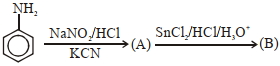
$'A'$ and $'B'$ in the following reactions are ${image}$
Globular protein is present in -
The descending order of acidity for the following carboxylic acid is :

$A.$ $CH _3 COOH$

$B.$ $F _3 C - COOH$

$C.$ $ClCH _2- COOH$

$D.$ $FCH _2- COOH$

$E.$ $BrCH _2- COOH$

Choose the correct answer from the options given below: