MCQ
Transitional elements exhibit variable valencies because they release electrons from the following orbits:
  • A
    $Ns$ orbit
  • B
    $Ns$ and $np$ orbits
  • $(n−1)d$ and $ns$ orbits
  • D
    $(n−1)d$ orbit

Answer

Correct option: C.
$(n−1)d$ and $ns$ orbits
The ability of the transition metals to exhibit variable valency is generally attributed to the availability of more electrons in the $(n−1)d$ orbitals which are closer to the outermost ns orbital in energy levels.

Need a full question paper?

Generate a complete, print-ready paper with questions like this in minutes — across 16+ boards, with answer keys.

Start Generating Free

Similar questions

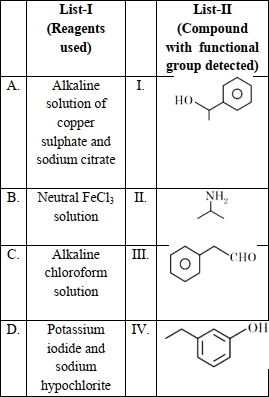
Match List$-I$ with List$-II$ :

Choose the correct answer from the options given below:
From the following which is not an emulsifer?
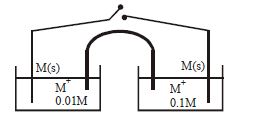
Initial $EMF$ of above cell at $298$ $K$ is .............. $\mathrm{V}$
$C{H_3}CON{H_2}\xrightarrow{{Na + ROH}}Z + {H_2}O.$ What is $Z$ ?
In the first transition series, the highest $B.P. $ and $M.P.$ is of
The following reaction is known as

${C_2}{H_5}OH + SOC{l_2}\xrightarrow{{{\text{Pyridine}}}}{C_2}{H_5}Cl + S{O_2} + HCl$

$\begin{matrix}
   \begin{matrix}
   C{{H}_{2}}OOCR'  \\
   |\,\,\,\,\,\,\,\,\,\,\,\,\,\,\,\,\,\,\,\,\,\,\,\,\,\,\,\,\,  \\
\end{matrix}\,\,\,  \\
   CHOOCR\,\,\,\,\,\,\,  \\
   |\,\,\,\,\,\,\,\,\,\,\,\,\,\,\,\,\,\,\,\,\,\,\,\,\,\,\,\,\,\,\,  \\
   C{{H}_{2}}OOCR'''  \\
\end{matrix}$  $\underset{\text{Hydrolysis}}{\mathop{\xrightarrow{\text{Enzyme}}}}$ $\begin{matrix}
   \begin{matrix}
   C{{H}_{2}}OH  \\
   |\,\,\,\,\,\,\,\,\,\,\,\,\,\,\,\,\,\,\,  \\
\end{matrix}  \\
   CHOH\,\,\,  \\
   |\,\,\,\,\,\,\,\,\,\,\,\,\,\,\,\,\,\,  \\
   C{{H}_{2}}OH  \\
\end{matrix}$  $+\begin{matrix}
   \begin{matrix}
   R'COOH  \\
   +  \\
\end{matrix}  \\
   R''COOH  \\
   +  \\
   R'''COOH  \\
\end{matrix}$

The enzyme used in the above reaction is

When neopentyl alcohol is heated with an acid, it slowly converted into an $85: 15$ mixture of alkenes $A$ and $B$, respectively. What are these alkenes $?$
When one of ampere current flows for $1\,\sec $ through a conductor, this quantity of electricity is known as
The pair in which both species have same magnetic moment (spin only value) is