Question
$\triangle PQR \sim \triangle PAB , m \angle P =60^{\circ}, PQ =6 cm, PR =4 cm$. Construct $\triangle PAB$, if $PQ : PA =3: 2$.

Answer

Get the step-by-step solution for this question inside the Vidyadip app.

Get the answer in the app

Need a full question paper?

Generate a complete, print-ready paper with questions like this in minutes — across 16+ boards, with answer keys.

Start Generating Free

Similar questions

Below is given frequency distribution of Daily wages (in ₹) of 130 workers.
Daily
wages (₹)
80-8485-8990-9495-99100-104105-109
No. of
workers
10202540305
Find the modal wage of a worker.
Solve the following quadratic equations by factorization:
$\frac{1}{(\text{x}-1)(\text{x}-2)}+\frac{1}{(\text{x}-2)(\text{x}-3)}+\frac{1}{(\text{x}-3)(\text{x}-4)}=\frac{1}{6}$
The median of the distribution given below is 14.4. Find the values of x and y, if the total frequency is 20.
Class interval:
0-6
6-16
12-18
18-24
24+30
Frequency:
4
x
5
y
1
In a $\triangle\text{ABC},\angle\text{B}=90^\circ,\text{AB}=24\text{cm}$ and BC = 7cm.
Find:
  1. $\sin\text{A}$
  2. $\cos\text{A}$
  3. $\sin\text{C}$
  4. $\cos\text{C}.$
The base PQ of two equilateral triangles PQR and PQR' with side $2a$ lies along y-axis such that the mid-point of PQ is at the origin. Find the coordinates of the vertices R and R' of the triangles.
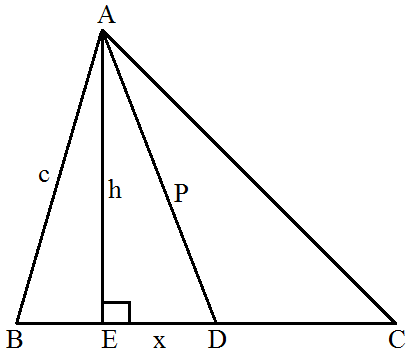
In the given figure, $D$ is the mid-point of side $BC$ and $\text{AE}\perp\text{BC}.$ If $BC = a, AC = b, AB = c, ED = x, AD = p$ and $AE = h$, prove that:
  1. $\text{b}^2=\text{p}^2+\text{ax}+\frac{\text{a}^2}{4}$
  2. $\text{c}^2=\text{p}^2-\text{ax}+\frac{\text{a}^2}{4}$
  3. $\text{b}^2+\text{c}^2=2\text{p}^2+\frac{\text{a}^2}{4}$
If $p^{\text {th }}, q^{\text {th }}$ and $r^{\text {th }}$ terms of an $A. P$. are $l, m, n$ respectively, show that
$(q-r) l+(r-p) m+(p-q) n=0$
The difference of two natural numbers is $3$ and the difference of their reciprocals is $\frac{3}{28}.$ Find the numbers.
If $\theta=\frac{15}{8},$ find the value of the all T-ratios of $\theta.$
ABCD is a rectangle whose three vertices are B(4, 0), C(4, 3) and D(0, 3). Find the length of one of its diagonal.