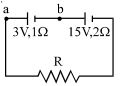
Two batteries one of the $\mathrm{emf}$ $3\,V$, internal resistance $1$ ohm and the other of $\mathrm{emf}$ $15\, V$, internal resistance $2$ $\mathrm{ohm}$ are connected in series with a resistance $R$ as shown. If the potential difference between $a$ and $b$ is zero the resistance of $R$ in $\mathrm{ohm}$ is
Medium


Download our appand get started for free
Experience the future of education. Simply download our apps or reach out to us for more information. Let's shape the future of learning together!No signup needed.*
Similar Questions
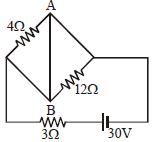
- 1View SolutionConsidering the following circuit, select the correct alternative
- 2A uniform metallic wire carries a current $2\,A$. when $3.4\,V$ battery is connected across it. The mass of uniform metallic wire is $8.92 \times 10^{-3} \,kg$. density is $8.92 \times 10^3\,kg / m ^3$ and resistivity is $1.7 \times 10^{-8} \Omega- m$. The length of wire is $l=............\,m$View Solution
- 3The value of internal resistance of an ideal cell is $\Omega$View Solution
- 4A current $I$ is passing through a wire having two sections $P$ and $Q$ of uniform diameters $d$ and $d/2$ respectively. If the mean drift velocity of electrons in sections $P$ and $Q$ is denoted by $v_P$ and $v_Q$ respectively, thenView Solution
- 5If a $0.1\%$ increase in length due to stretching, the percentage increase in its resistance will be ............ $\%$View Solution
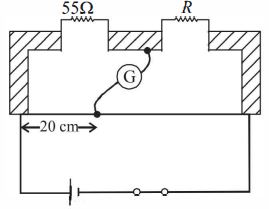
- 6A wire of resistance $160\,\Omega$ is melted and drawn in wire of one-fourth of its length. The new resistance of the wire will be $......\Omega$View Solution
- 7An electric bulb of $500 \,watt$ at $100\, volt$ is used in a circuit having a $200\, {V}$ supply. Calculate the resistance ${R}$ to be connected in series with the bulb so that the power delivered by the bulb is $500\, {W}$. (in $\Omega$)View Solution
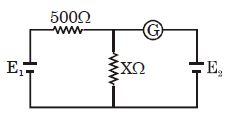
- 8In the adjoining circuit, the battery $E_1$ has an $e.m.f.$ of $12\, volts$ and zero internal resistance, while the battery $E_2$ has an $e.m.f.$ of $2\, volts$. If the galvanometer $G$ reads zero, then the value of the resistance $X$ in $ohms$ isView Solution
- 9A wire $50\, cm$ long and $1\;mm^2$ in cross -section carries a current of $4\; A$ when connected to a $2\; V$ battery. The resistivity of the wire isView Solution
- 10Shown in the figure below is a meter-bridge set up with null deflection in the galvanometer. The value of the unknown resistor $R$ is ............. $\Omega$View Solution