MCQ
Two bodies are thrown simultaneously from a tower with same initial velocity ${v_0}:$ one vertically upwards, the other vertically downwards. The distance between the two bodies after time $t$ is
  • A
    $2{v_0}t + \frac{1}{2}g\,{t^2}$
  • $2{v_0}t$
  • C
    ${v_0}t + \frac{1}{2}g\,{t^2}$
  • D
    ${v_0}t$

Answer

Correct option: B.
$2{v_0}t$
b
(b) For vertically upward motion, ${h_1} = {v_0}t - \frac{1}{2}g\,{t^2}$and for vertically down ward motion, ${h_2} = {v_0}t + \frac{1}{2}g\;{t^2}$

$\therefore $ Total distance covered in $t \,sec$ $h = {h_1} + {h_2} = 2{v_o}t$.

Need a full question paper?

Generate a complete, print-ready paper with questions like this in minutes — across 16+ boards, with answer keys.

Start Generating Free

Similar questions

Which one of the following energies cannot be possessed by a body at rest?
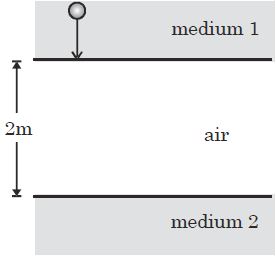
A bead is moving in medium $1$ with a uniform speed of $1\, m \,s^{-1}$ for $2.5\, s$. Then it enters into air and falls freely under gravity for $2\, m$. Finally, it enters medium $2$ and immediately moves with uniform speed for $1.5\, s$. The total distance the bead has traveled, is.........$m$ $(g = 10\, m/s^2$):
A particle is acted upon by a force of constant magnitude which is always perpendicular to the velocity of the particle. The motion of the particle takes place in a plane. It follows that:
When a mass $m$ is attached to a spring, it normally extends by $0.2\, m$. The mass $m$ is given a slight addition extension and released, then its time period will be
According to the law of energy equalization the value of average energy of a molecule of diatomic gas will be:
There have been suggestions that the value of the gravitational constant G becomes smaller when considered over very large time period (in billions of years) in the future. If that happens, for our earth,
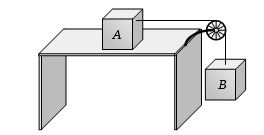
A block $A$ of mass $7 \,kg$ is placed on a frictionless table. A thread tied to it passes over a frictionless pulley and carries a body $B$ of mass $3\, kg$ at the other end. The acceleration of the system is .......... $ms^{-2}$          (given g = 10$m{s^{ - 2}})$
A particle is moving with speed $6\,m/s$ along the direction of  $\vec A = 2\hat i + 2\hat j - \hat k,$ then its velocity is
All the particles of a body are situated at a distance R from the origin. The distance of the centre of mass of the body from the origin is:
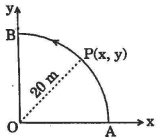
A point $P$ moves in counter-clockwise direction on a circular path as shown in the figure. The movement of '$P$' is such that it sweeps out a length  $s = t^3+5$, where s is in metres and $t$ is in seconds. The radius of the path is $20\ m$. The acceleration of '$P$' when $t = 2\ s$ is nearly ..........  $m/s^2$