Question
Two bodies make an elastic head-on collision on a smooth horizontal table kept in a car. Do you expect a change in the result if the car is accelerated on a horizontal road because of the noninertial character of the frame? Does the equation "Velocity of separation = Velocity of approach" remain valid in an accelerating car? Does the equation "Final momentum = Initial momentum" remain valid in the accelerating car?

Answer

In case car is accelerated it would affect velocity of both bodies,
  1. In this case the change in velocity would affect velocity of both bodies. (body moving in direction of car would slow down and other one moving in opposite direction would speed up in case car is accelerated)
  2. Velocity of separation would be equal to velocity of approach. As only change would be in velocity but everything would remain same.
  3. Yes final momentum would be still equal to initial momentum as with increase in velocity of one body the velocity of other body does decrease.

Need a full question paper?

Generate a complete, print-ready paper with questions like this in minutes — across 16+ boards, with answer keys.

Start Generating Free

Similar questions

The distance of the Sun from the Earth is 1.496 × 10¹¹ m (i.e., 1 A.U.). If the angular diameter of the Sun is 2000”, find the diameter of the Sun.
The farthest objects in our Universe discovered by modern astronomers are so distant that light emitted by them takes billions of years to reach the Earth. These objects (known as quasars) have many puzzling features, which have not yet been satisfactorily explained. What is the distance in km of a quasar from which light takes 3.0 billion years to reach us?
A U-tube contains water and methylated spirit separated by mercury. The mercury columns in the two arms are in level with 10.0cm of water in one arm and 12.5cm of spirit in the other. What is the specific gravity of spirit?
Define molar specific heat. Write its units.
Is it possible for two bodies to be in thermal equilibrium if they are not in contact?
A vessel A contains hydrogen and another vessel B whose volume is twice of A contains same mass of oxygen at the same temperature. Compare (i) average kinetic energies of hydrogen and oxygen molecules (ii) root mean square speeds of the molecules (iii) pressure of gases in A and B. Molecular weights of hydrogen and oxygen are 2 and 32 respectively.
Figure, shows an aluminium rod joined to a copper rod. Each of the rods has a length of 20cm and area of cross section 0.20cm2. The junction is maintained at a constant temperature 40°C and the two ends are maintained at 80°C. Calculate the amount of heat taken out from the cold junction in one minute after the steady state is reached. The conductivities are KAI = 200wm-1°C-1 and Kcu = 400wm-1°C-1.

There are two displacement vectors, one of magnitude 3 metres and the other of 4 metres. How would the two vectors be added so that the magnitude of the resultant vector be (a) 7 metres (b) 1 metre and (c) 5 metres?
Two blocks of mares 10kg and 20kg are placed on the X-axis. The first mass is moved on the axis by a distance of 2cm. By what distance should the second mass be moved to keep the position of the centre of mass unchanged?
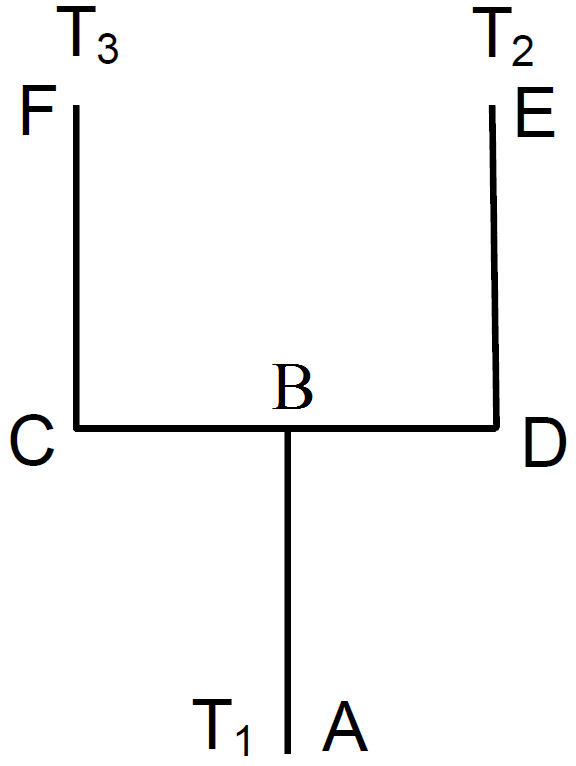
Four identical rods AB, CD, CF and DE are joined as shown in figure. The length, cross-sectional area and thermal conductivity of each rod are l, A and K respectively. The ends A, E and F are maintained at temperatures T1, T2 and T3 respectively. Assuming no loss of heat to the atmosphere, find the temperature at B.