MCQ
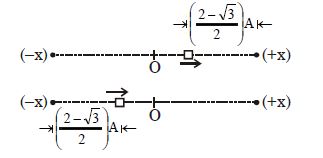
Two bodies performing $SHM$ have same amplitude and frequency. Their phases at a certain instant are as shown in the figure. The phase difference between them is
  • $\frac{{2\pi }}{3}$
  • B
    $\pi $
  • C
    $\frac{\pi }{3}$
  • D
    None of these

Answer

Correct option: A.
$\frac{{2\pi }}{3}$
a
Displacement form mean position

$=\mathrm{A}-\left(\frac{2-\sqrt{3}}{2}\right) \mathrm{A}=\frac{\sqrt{3}}{2} \mathrm{A}$

So phase of the particle which is going

towards $+x$ is $\phi_{1}=\frac{\pi}{3}$

and for other particle $\phi_{2}=2 \pi-\frac{\pi}{3}=\frac{5 \pi}{3}$

phase difference $=\frac{5 \pi}{3}-\frac{\pi}{3}$

$=\frac{4 \pi}{3}$ or $\left(2 \pi-\frac{4 \pi}{3}\right)$

$=\frac{4 \pi}{3}$ or $\frac{2 \pi}{3}$

Need a full question paper?

Generate a complete, print-ready paper with questions like this in minutes — across 16+ boards, with answer keys.
Start Generating Free

Similar questions

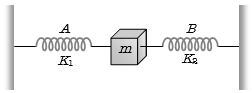
In arrangement given in figure, if the block of mass m is displaced, the frequency is given by
A proton and an anti-proton come close to each other in vacuum such that the distance between them is $10 \,cm$. Consider the potential energy to be zero at infinity. The velocity at this distance will be ........... $\,m / s$
The motion of a particle represented by $y\ =$ $\sin \omega t - \cos \omega t$ is
A particle moves in the $X-Y$ plane under the influence of a force such that its linear momentum is $\overrightarrow{\mathrm{p}}(t)=A[\hat{\mathrm{i}} \cos (\mathrm{kt})-\hat{\mathrm{j}} \sin (\mathrm{kt})]$, where $A$ and $k$ are constants. The angle between the force and the momentum is
A vector is added to an equal and opposite vector of similar nature, forms a ........
A spaceship of mass $2 \times 10^4\,kg$ is launched into a circular orbit close to the earth surface. The additional velocity to be imparted to the spaceship in the orbit to overcome the gravitational pull will be $......$ (if $g =10\,m / s ^2$ and radius of earth $=6400\,km$ )
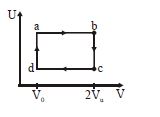
The figure given below shows the variation in the internal energy $U$ with volume $V$ of $2.0\ mole$ of an ideal gas in a cyclic process $abcda$ . The temperatures of the gas during the processes $ab$ and $cd$ are $500\ K$ and $300\ K$ respectively, the heat absorbed by the gas during the complete process is  .... $J$

(Take $R$ = $8.3\ J/mol-K$ and $ln\ 2$ = $0.69$)
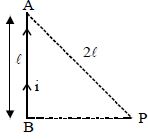
The magnetic field at point, point $P$ will be :-
A block is lying on an inclined plane which makes $60^°$ with the horizontal. If coefficient of friction between block and plane is $0.25$ and $g = 10\,m/{s^2}$, then acceleration of the block when it moves along the plane will be ........ $m/s^2$
The correct relation between limit of resolution and resolving power is