Two bulbs of $500\, watt$ and $200\, watt$ are manufactured to operate on $220\, volt$ line. The ratio of heat produced in $500\, W$ and $200\, W$, in two cases, when firstly they are joined in parallel and secondly in series, will be
Diffcult
Download our app for free and get started
(a) Resistance ${R_1}$ of $500\, W$ bulb $ = \frac{{{{(220)}^2}}}{{500}}$
Resistance ${R_2}$ of $200\, W$ bulb $ = \frac{{{{(220)}^2}}}{{200}}$
When joined in parallel, the potential difference across both the bulbs will be same.
Ratio of heat produced $ = \frac{{{V^2}/{R_1}}}{{{V^2}/{R_2}}} = \frac{{{R_2}}}{{{R_1}}} = \frac{5}{2}$
When joined in series, the same current will flow through both the bulbs.
Ratio of heat produced $ = \frac{{{i^2}{R_1}}}{{{i^2}{R_2}}} = \frac{{{R_1}}}{{{R_2}}} = \frac{2}{5}$
Resistance ${R_2}$ of $200\, W$ bulb $ = \frac{{{{(220)}^2}}}{{200}}$
When joined in parallel, the potential difference across both the bulbs will be same.
Ratio of heat produced $ = \frac{{{V^2}/{R_1}}}{{{V^2}/{R_2}}} = \frac{{{R_2}}}{{{R_1}}} = \frac{5}{2}$
When joined in series, the same current will flow through both the bulbs.
Ratio of heat produced $ = \frac{{{i^2}{R_1}}}{{{i^2}{R_2}}} = \frac{{{R_1}}}{{{R_2}}} = \frac{2}{5}$

Download our appand get started for free
Experience the future of education. Simply download our apps or reach out to us for more information. Let's shape the future of learning together!No signup needed.*
Similar Questions
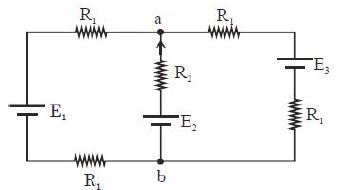
- 1For the circuit shown, with ${R_1} = 1.0\,\Omega $, ${R_2} = 2.0\,\Omega $, ${E_1} = 2\,V$ and ${E_2} = {E_3} = 4\,V$, the potential difference between the points $‘a’$ and $‘b’$ is approximately (in $V$)View Solution
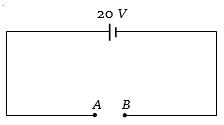
- 2In the shown circuit, what is the potential difference across $A$ and $B$ ......... $V$View Solution
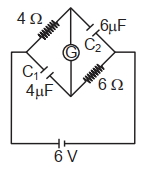
- 3A galvanometer $(G)$ $\Omega$ of 2 risistance is connected in the givn circuit the raito of charge in $C_1$ and $C_2$ is:View Solution
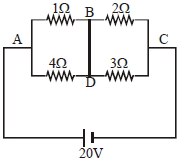
- 4In the given circuit diagram, a wire is joining points $B$ and $D$. The current in this wire is ............. $A$View Solution
- 5View SolutionSelect the correct statement
- 6The $e.m.f.$ of a standard cell balances across $150\, cm$ length of a wire of potentiometer. When a resistance of $2\,\Omega $ is connected as a shunt with the cell, the balance point is obtained at $100\,cm$. The internal resistance of the cell is .............. $\Omega $View Solution
- 7The current $I$ drawn from the $5$ volt source will be ............... $A$View Solution
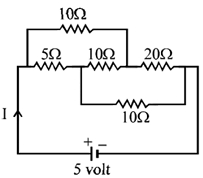
- 8In the circuit shown in figure, the resistance of voltmeter is $6\, k\Omega $. The voltmeter reading will be ................. $\mathrm{V}$View Solution
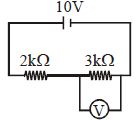
- 9A resistor develops $500\, J$ of thermal energy in $20 \,s$ when a current of $1.5\, A$ is passed through it. If the current is increased from $1.5 \,A$ to $3\, A$ what will be the energy (in $J$) developed in $20\, s$.View Solution
- 10Two wires each of radius of cross section $r$ but of different materials are connected together end to end (in series). If the densities of charge carriers in the two wires are in the ratio $1 : 4$, the drift velocity of electrons in the two wires will be in the ratio:View Solution