Question
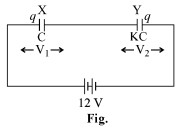
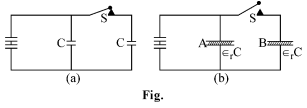
Two capacitors of equal capacitance are connected to a battery as shown. Switch $S$ is initially in closed state. Now the switch $S$ is opened and a material of dielectric constant $\epsilon_r=3$ is filled between the plates of the capacitor. Find the ratio of the values of electrical energy stored in the capacitors before and after placing the dielectric material. Image
Answer

Initially, when the switch $S$ is closed, both the capacitors will be at the same potential $V$ because they are connected in parallel,
i.e., $ U_i =\frac{1}{2} C_1 V^2+\frac{1}{2} C_2 V^2$
$ =\frac{1}{2}\left(C_1+C_2\right) V^2=CV^2 $
$(i)$ When dielectric material is placed between the plates of the capacitor by keeping the switch $S$ open, then the capacitance of each capacitor will become $\epsilon_r$ times. And since capacitor $A$ is still connected to the battery. Therefore, the value of potential difference on it will be equal to the value $V$ of the initial potential difference, whereas the new value of potential difference on capacitor $B$ will become $V ^{\prime}$
$=\frac{ V }{\epsilon_r}$ and the charge will remain constant. Therefore in this situation the electric energy of the system will be :
$U _f=\frac{1}{2} C ^{\prime} V ^2+\frac{1}{2} C ^{\prime} V ^{\prime 2}$
$=\frac{1}{2} \epsilon_r CV ^2+\frac{1}{2} \epsilon_r C \left(\frac{ V }{\epsilon_r}\right)^2$
$\because V ^{\prime}=\frac{ V }{\epsilon_r}$ and $C ^{\prime}=\epsilon_r C$
$=\frac{1}{2} CV ^2\left(\epsilon_r+\frac{1}{\epsilon_r}\right)=\frac{1}{2} CV ^3\left(3+\frac{1}{3}\right)$
$=$$\frac{1}{2} CV ^2\left(\frac{10}{3}\right)$
Image
On dividing eq.$(ii)$ by eq. $(i),$
Therefore, $ \frac{U_f}{U_i}=\frac{\frac{10}{6} CV^2}{CV^2} $ or $ \frac{U_f}{U_i}$
$=1.66$
$\because \epsilon_r=3$ Ans.

Need a full question paper?

Generate a complete, print-ready paper with questions like this in minutes — across 16+ boards, with answer keys.

Start Generating Free

Similar questions

One person says that the potential energy of a particular book kept in an almirah is 20J and the other says it is 30J. Is one of them necessarily wrong?
Answer the following question:
Ray optics is based on the assumption that light travels in a straight line. Diffraction effects (observed when light propagates through small apertures/slits or around small obstacles) disprove this assumption. Yet the ray optics assumption is so commonly used in understanding location and several other properties of images in optical instruments. What is the justification?
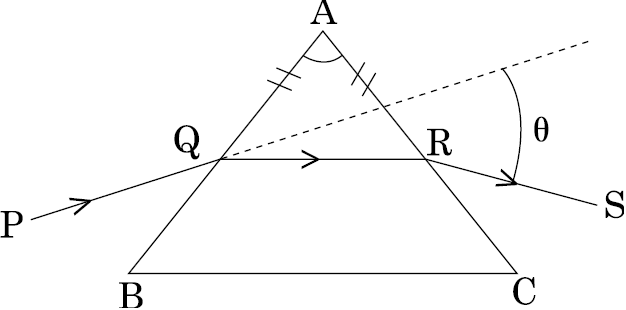
A ray PQ incident on the refracting face BA is refracted in the prism BAC as shown in the figure and emerges from the other refracting face AC as RS such that AQ = AR. If the angle of prism $A = 60^\circ$ and refractive index of material of prism is$\sqrt{3}$, calculate angle $\theta.$
Describe the two experiments related to static friction with diagram.
Two bulbs are rated $(P_1, V)$ and $(P_2, V)$. If they are connected in series in parallel across a supply V.
Find the power dissipated in the two combinations in terms of $P_1$ and $P_2$.
Radioactive $^{131}I$ has a half-life of 8.0 days. A sample containing $^{131}I$ has activity $20\mu\text{Ci}$ at $t = 0.$
  1. What is its activity at t = 4 days?
  2. What is its decay constant at t = 4.0 days?
Explain controlled thermonuclear fusion.
An e.m. wave is travelling in a medium with a velocity v = $v \hat{i}$. The electric field oscillations, of this e.m. wave, are along the $y$-axis.
a. Identify the direction in which the magnetic field oscillations are taking place, of the e.m. wave.
b. How are the magnitudes of the electric field and magnetic fields in the electromagnetic wave related to each other?
A rectangular coil of 100 turns has length 5cm and width 4cm. It is placed with its plane parallel to a uniform magnetic field and a current of 2A is sent through the coil. Find the magnitude of the magnetic field B if the torque acting on the coil is $0.2N\  m^{-1}.$
Under what condition, force on moving charged particle in a magnetic field will be (i) maximum (ii) minimum?