Question
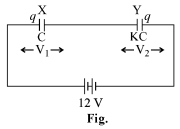
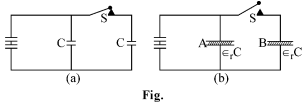
Two capacitors of equal capacitance are connected to a battery as shown. Switch S is initially in closed state. Now the switch $S$ is opened and a material of dielectric constant $\in_r=3$ is filled between the plates of the capacitor. Find the ratio of the values of electrical energy stored in the capacitors before and after placing the dielectric material. Image
Answer

Initially, when the switch S is closed, both the capacitors will be at the same potential V because they are connected in parallel, i.e.,
$ \begin{aligned} U_i & =\frac{1}{2} C_1 V^2+\frac{1}{2} C_2 V^2 \\ & =\frac{1}{2}\left(C_1+C_2\right) V^2=CV^2 \end{aligned} $
(i) When dielectric material is placed between the plates of the capacitor by keeping the switch S open, then the capacitance of each capacitor will become $\in_r$ times. And since capacitor A is still connected to the battery. Therefore, the value of potential difference on it will be equal to the value V of the initial potential difference, whereas the new value of potential difference on capacitor $B$ will become $V ^{\prime}$ $=\frac{ V }{\in_r}$ and the charge will remain constant. Therefore in this situation the electric energy of the system will be :
$U _f=\frac{1}{2} C ^{\prime} V ^2+\frac{1}{2} C ^{\prime} V ^{\prime 2}$
$=\frac{1}{2} \in_r CV ^2+\frac{1}{2} \in_r C \left(\frac{ V }{\in_r}\right)^2$
$\because V ^{\prime}=\frac{ V }{\in_r}$ and $C ^{\prime}=\in_r C$
$=\frac{1}{2} CV ^2\left(\in_r+\frac{1}{\in_r}\right)=\frac{1}{2} CV ^3\left(3+\frac{1}{3}\right)$
$=$$\frac{1}{2} CV ^2\left(\frac{10}{3}\right)$
Image
On dividing eq.(ii) by eq. (i),
Therefore, $ \frac{U_f}{U_i}=\frac{\frac{10}{6} CV^2}{CV^2} $ or $ \begin{array}{l} \frac{U_f}{U_i} \\ =1.66 \\
\because \in_r=3 \quad \text { Ans. } \end{array} $

Need a full question paper?

Generate a complete, print-ready paper with questions like this in minutes — across 16+ boards, with answer keys.

Start Generating Free

Similar questions

A positive charge q is placed in front of a conducting solid cube at a distance d from its centre. Find the electric field at the centre of the cube due to the charges appearing on its surface.
State Brewster’s law.
The value of Brewster angle for a transparent medium is different for light of different colours. Give reason.
A metal rod of square cross-sectional area A having length l has current I flowing through it when a potential difference of V volt is applied across its ends (figure I). Now the rod is cut parallel to its length into two identical pieces and joined as shown in figure II. What potential difference must be maintained across the length 2l so that the current in the rod is still I?

The atmospheric temperature in the cities on sea-coast change very little. Explain.
In an electrolyte, the positive ions move from left to right and the negative ions from right to left. Is there a net current? If yes, in what direction?
A barometer is constructed with its tube having radius 1.0mm. Assume that the surface of mercury in the tube is spherical in shape. If the atmospheric pressure is equal to 76cm of mercury, what will be the height raised in the barometer tube. The contact angle of mercury with glass = 135º and surface tension of mercury = 0.465N/m. Density of mercury = 13600kg/m3.
An electric dipole of dipole moment $2\times10^{-6}cm$ is kept inside a closed surface. What will be the net flux coming out from the surface ?
  1. When a wave is propagating from a rarer to a denser medium, which characteristic of the wave does not change and why?
  2. What is the ratio of the velocity of the wave in the two media of refractive indices $\mu_{1}$ and $\mu_{2}$?
The ground state energy of hydrogen atom is –13.6 eV. What are the kinetic and potential energies of the electron in this state?
Each of the batteries shown in figure has an emf equal to 5V. Show that the magnetic field B at the point P is zero for any set of values of the resistances.