Question
Two cards are selected at random from a box which contains five cards numbered $1, 1, 2, 2,$ and $3.$ Let $X$ denote the sum and $Y$ the maximum of the two numbers drawn. Find the probability distribution, mean and variance of $X$ and $Y.$

Answer

Box contains five cards $1, 1, 2, 2, 3$.
Here, $X$ denotes the sum of the two number on cards drawn.
$Y$ denotes the maximum of the two number.
So, $X = 2, 3, 4, 5 Y = 1, 2, 3 P(X = 2) = P(1)P(1) =\frac{2}{5}\times\frac{1}{4}$
$=0.1 P(X = 3) = P(1)P(2) + P(2)P(1) =\frac{2}{5}\times\frac{2}{4}+\frac{2}{5}\times\frac{2}{4}$
$=0.4 P(X = 4) = P(2)P(2) + P(1)P(3) + P(3)P(1) =\frac{2}{5}\times\frac{1}{4}+\frac{2}{5}\times\frac{1}{4}+\frac{1}{5}\times\frac{2}{4}$
$=0.3 P(X = 5) = P(2)P(3) + P(3)P(2) =\frac{2}{5}\times\frac{2}{4}+\frac{1}{5}\times\frac{2}{4}$
$=0.2 Probability distribution for X$
$x:$ $2$ $3$ $4$ $5$
$P(x):$ $0.1$ $0.4$ $0.3$ $0.2$
Now,
$x_i$ $p_i$ $x_ip_i$ $x_i^2p_i$
$2$ $0.1$ $0.1$ $0.4$
$3$ $0.4$ $1.2$ $3.6$
$4$ $0.3$ $1.2$ $4.8$
$5$ $0.2$ $1.0$ $5.0$
$
$
$
$
$\sum\text{xp}=3.6$ $\sum\text{x}^2\text{p}=13.8$
Mean $=\sum\text{xp}$ Mean $= 3.6$ Variance $=\sum\text{x}^2\text{p}-(\text{mean})^2 =13.8-(3.6)^2 =13.8-12.96$ Variance $= 0.84 P(Y = 1) = P(1)P(1) =\frac{2}{5}\times\frac{1}{4} =\frac{2}{20} =0.1 P(Y = 2) = P(1)P(2) + P(2)P(1) + P(2)P(2)$
$ =\frac{2}{5}\times\frac{2}{4}+\frac{2}{5}\times\frac{2}{4}+\frac{2}{5}\times\frac{1}{4}$
$=0.5 P(Y = 3) = P(1)P(3) + P(2)P(3) + P(3)P(1) + P(3)P(2)$
$=\frac{2}{5}\times\frac{1}{4}+\frac{2}{5}\times\frac{1}{4}+\frac{1}{5}\times\frac{2}{4}+\frac{1}{5}\times\frac{2}{4}$
 $=0.4$ Probability distribution for $Y$ is
$x:$ $1$ $2$ $3$
$p(x):$ $0.1$ $0.5$ $0.4$
 
$y_i$ $p_i$ $y_ip_i$ $y_i^2p_i$
$1$ $0.1$ $0.1$ $0.1$
$2$ $0.5$ $1.0$ $2.0$
$3$ $0.4$ $1.2$ $3.6$
$
$
$
$
$\sum\text{xp}=2.3$ $\sum\text{x}^2\text{p}=5.7$
Mean $=\sum\text{xp}=2.3$ Variance $=\sum\text{x}^2\text{p}-(\text{mean})^2 =5.1-(2.3)^2$ Variance $= 0.41$

Need a full question paper?

Generate a complete, print-ready paper with questions like this in minutes — across 16+ boards, with answer keys.
Start Generating Free

Similar questions

Find the equation of the curve which passes through the point (1, 2) and the distance between the foot of the ordinate of the point of contact and the point of intersection of the tangent with x-axis twice abscissa of the pont of contact.
Write the minimum value of $f(x) = x^x .$
If $\text{x}\sin(\text{a}+\text{y})+\sin\text{a}\cos(\text{a}+\text{y})=0,$ prove that $\frac{\text{dy}}{\text{dx}}=\frac{\sin^2(\text{a}+\text{y})}{\sin\text{a}}$
Show that the points A(1, -2, -8), B(5, 0, -2) and C(11, 3, 7) are collinear, and find the ratio in which B divides AC.
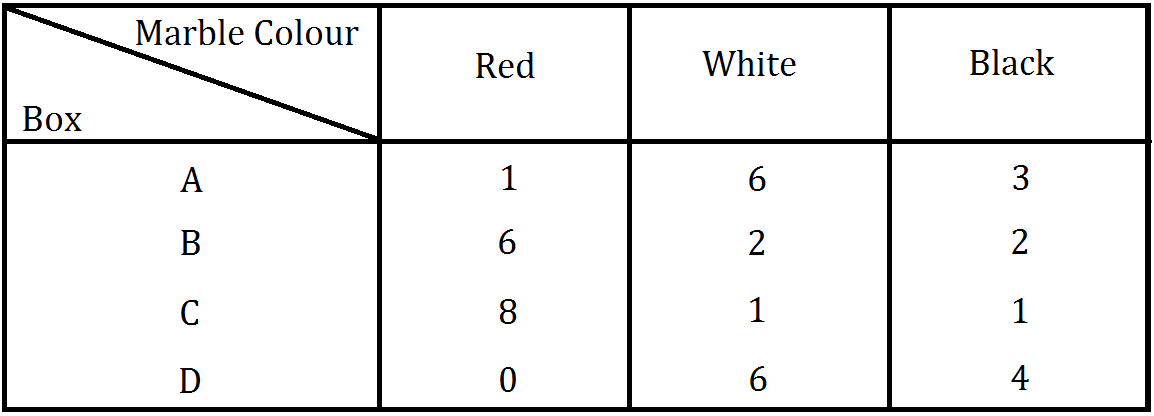
Suppose we have four boxes A, B, C, D containing coloured marbles as given below:
One of the boxes has been selected at random and a single marble is drawn from it. If the marble is red, what is the probability that it was drawn from,
  1. Box A?
  2. Box B?
  3. Box C?
Verify Rolle's theorem of the following function on the indicated interval
$\text{f}(\text{x})=\frac{6\text{x}}{\pi}-4\sin^{2}\text{x}\text{ on }\Big[0,\frac{\pi}{6}\Big]$
Evaluate the following integrals:
$\int\limits^{\frac{3}{2}}_0\big|\text{x}\cos\pi\text{x}\big|\text{dx}$
Evaluate:
$\int\limits^{\pi/4}_{0}\bigg(\frac{\sin \text{x} +\cos \text{x}}{3 + \sin 2\text{x}}\bigg)\text{dx}$
Two schools P and Q want to award their selected students on the values of Discipline, Politeness and Punctuality. The school P wants to award ₹ x each, ₹ y each and ₹ z each the three respectively values to its 3, 2 and 1 students with a total award money of ₹ 1,000School Q wants to spend ₹ 1,500 to award its 4, 1 and 3 students on the respective values (by giving the same award money for three values as before). If the total amount of awards for one prize on each value is ₹ 600, using matrices, find the award money for each value. Apart from the above three values, suggest one more value for awards.
Using properties of determinants, prove that
$\begin{vmatrix} \text{a}^2+2\text{a}& 2\text{a}+1 & 1\\ 2\text{a}+1 & \text{a}+2 & 1 \\ 3 & 3 & 1 \end{vmatrix}=(\text{a}-1)^3$