MCQ
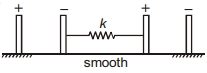
Two charged capacitors have their outer plates fixed and inner plates connected by a spring of force constant ' $k$ '. The charge on each capacitor is q. Find the extension in the spring at equilibrium
  • $\frac{q^2}{2 A \varepsilon_0 k}$
  • B
    $\frac{q^2}{4 A \varepsilon_0 k}$
  • C
    $\frac{q^2}{A \varepsilon_0 k}$
  • D
    $0$

Answer

Correct option: A.
$\frac{q^2}{2 A \varepsilon_0 k}$
a
(a)

$F=k x=\frac{q^2}{2 A \varepsilon_0}$

$x=\frac{q^2}{2 A \varepsilon_0 k}$

Need a full question paper?

Generate a complete, print-ready paper with questions like this in minutes — across 16+ boards, with answer keys.

Start Generating Free

Similar questions

A beam of natural light falls on a system of 6 polaroids, which are arranged in succession such that each polaroid is turned through 30° with respect to the preceding one. The percentage of incident intensity that passes through the system will be
Which among the following can be used to analyze circuits?
A ray reflected successively from two plane mirrors inclined at a certain angle undergoes a deviation of $270^o$ after total two reflections. The number of images observable are
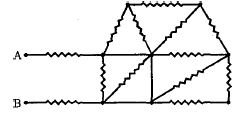
In the given circuit all resistances are of value $R\,ohm$ each. The equivalent resistance between $A$ and $B$ is 
A zone plate of focal length 60 cm, behaves as a convex lens, If wavelength of incident light is $6000A^o$, then radius of first half period zone will be
Given below are two statements:

Statement $I$: Atoms are electrically neutral as they contain equal number of positive and negative charges.

Statement $II$: Atoms of each element are stable and emit their characteristic spectrum.

In the light of the above statements, choose the most appropriate answer from the options given below.

The ratio of minimum to maximum wavelength in Balmer series is
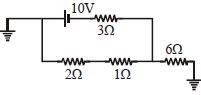
 Find current in $6\,\Omega $ resistance
How will the voltage $(V)$ between the two plates of a parallel plate capacitor depend on the distance $(d)$ between the plates, if the charge on the capacitor remains the same?
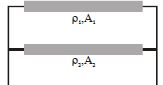
Two conductors of same length are connected in parallel as shown in figure. Their cross-sectional areas $A_1$ and $A_2$ and their resistivities are ${\rho _1}$ and  ${\rho _2}$ respectively. The equivalent resistivity of this combination is