MCQ
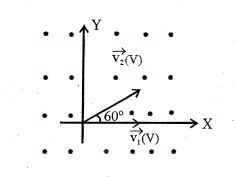
Two charged particles of mass $m$ and charge $q$ each are projected from origin simultaneously with same speed $V$ in transverse magnetic field. If ${\vec r_1}$ and ${\vec r_2}$ are the position vectors of particles (with respect to origin) at $t = \frac{{\pi m}}{{qB}}$ then the value of  ${\vec r_1}.{\vec r_2}$ at that time is
  • A
    ${\left( {\frac{{mv}}{{qB}}} \right)^2}$
  • B
    $\frac{1}{2}{\left( {\frac{{mv}}{{qB}}} \right)^2}$
  • $2{\left( {\frac{{mv}}{{qB}}} \right)^2}$
  • D
    $4{\left( {\frac{{mv}}{{qB}}} \right)^2}$

Answer

Correct option: C.
$2{\left( {\frac{{mv}}{{qB}}} \right)^2}$
c
$\overrightarrow{\mathrm{r}}_{1} \cdot \overrightarrow{\mathrm{r}}_{2}=\left(\mathrm{r} \times \mathrm{r} \times \cos \left(60^{\circ}\right)\right.$

$=\frac{1}{2} r^{2}=\frac{1}{2}(2 R)^{2}=2 R^{2}=2\left(\frac{m v}{q B}\right)$

Need a full question paper?

Generate a complete, print-ready paper with questions like this in minutes — across 16+ boards, with answer keys.

Start Generating Free

Similar questions

Which radiation in sunlight, causes heating effect
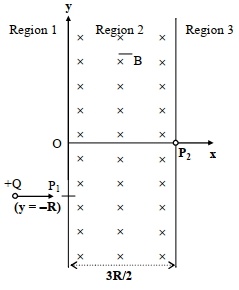
A uniform magnetic field $B$ exists in the region between $x=0$ and $x=\frac{3 R}{2}$ (region $2$ in the figure) pointing normally into the plane of the paper. A particle with charge $+Q$ and momentum $p$ directed along $x$-axis enters region $2$ from region $1$ at point $P_1(y=-R)$. Which of the following option(s) is/are correct?

$[A$ For $B>\frac{2}{3} \frac{p}{QR}$, the particle will re-enter region $1$

$[B]$ For $B=\frac{8}{13} \frac{\mathrm{p}}{QR}$, the particle will enter region $3$ through the point $P_2$ on $\mathrm{x}$-axis

$[C]$ When the particle re-enters region 1 through the longest possible path in region $2$ , the magnitude of the change in its linear momentum between point $P_1$ and the farthest point from $y$-axis is $p / \sqrt{2}$

$[D]$ For a fixed $B$, particles of same charge $Q$ and same velocity $v$, the distance between the point $P_1$ and the point of re-entry into region $1$ is inversely proportional to the mass of the particle

A uniform electric field pointing in positive $x$-direction exists in a region. Let $A$ be the origin, $B$ be the point on the $x$-axis at $x = + 1$ $cm$ and $C$ be the point on the $y$-axis at $y = + 1\,cm$. Then the potentials at the points $A$, $B$ and $C$ satisfy
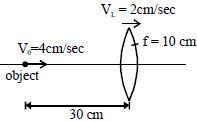
Find out velocity of image of given object....$cm/sec$
Two metal pieces having a potential difference of 800 V are 0.02 m apart horizontally. A particle of mass $1.96 \times 10^{-15} \mathrm{~kg}$ is suspended in equilibrium between the plates. If e is the elementary charge, then charge on the particle is
When we remove polyester or woollen clothes in dark, we can see a spark and hear a crackling sound. Which of the following is responsible for it?
In a certain region static electric and magnetic fields exist. The magnetic field is given by $\vec B = {B_0}\left( {\hat i + 2\hat j - 4\hat k} \right)$. If a test charge moving with a velocity $\vec v = {v_0}\left( {3\hat i - \hat j + 2\hat k} \right)$ experiences no force in that region, then the electric field in the region, in $SI\, units$, is
Half life of radioactive element depends upon
A hydrogen atom is in ground state. In order to get six lines in its emission spectrum, wavelength of incident radiation should be .......... $\mathring A$
The centre of mass of a system of particles is at the origin. It follows that: