MCQ
Two charged particles traverse identical helical paths in a completely opposite sense in a uniform magnetic field.
  • A
    They have equal $z-$components of momenta.
  • B
    They must have equal charges.
  • C
    They necessarily represent a particle$-$antiparticle pair.
  • The charge to mass ratio satisfy: $\Big(\frac{\text{e}}{\text{m}}\Big)_1+\Big(\frac{\text{e}}{\text{m}}\Big)_2=0$.
Answer

Correct option: D.
The charge to mass ratio satisfy: $\Big(\frac{\text{e}}{\text{m}}\Big)_1+\Big(\frac{\text{e}}{\text{m}}\Big)_2=0$.

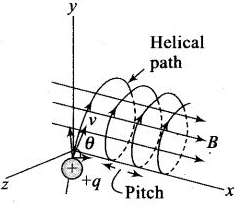
Key concept: In this situation if the particle is thrown in $x-y$ plane $($as shown in figure$)$ at some angle $\theta $ with velocity v, then we have to resolve the velocity of the particle in rectangular components, such that one component is along the field $(v \cos \theta )$ and other one is perpendicular to the field $(v \sin \theta )$. We find that the particle moves with constant velocity $v \cos \theta $ along the field. The distance covered by the particle along the magnetic field is called pitch.


The pitch of the helix, $($i.e., linear distance travelled in one rotation$)$ will be given by
$\text{p}=\text{T}(\text{v}\cos\theta)=2\text{p}\frac{\text{m}}{\text{qB}}(\text{v}\cos\theta)$
For given pitch $p$ correspond to charge particle, we have
$\frac{\text{q}}{\text{m}}=\frac{2\pi\text{v}\cos\theta}{\text{qB}}=\text{constant}$
Here in this case, charged particles traverse identical helical paths in a completely opposite sense in a uniform magnetic field B, $\text{LHS}$ for two particles should be same and of opposite sign. Therefore,
$\Big(\frac{\text{e}}{\text{m}}\Big)_1+\Big(\frac{\text{e}}{\text{m}}\Big)_2=0$

Need a full question paper?

Generate a complete, print-ready paper with questions like this in minutes — across 16+ boards, with answer keys.

Start Generating Free