Question
Two charges q and -3q are placed fixed on x-axis separated by distance 'd'. Where should a third charge 2q be placed such that it will not experience any force?

Answer

The force on any charge will be zero only if net electric field at the position of charge is zero. Let electric field is zero at a distance x from charge q.

At point $\text{P},\vec{\text{E}_\text{A}}+\vec{\text{E}_\text{B}}=0\Rightarrow|\vec{\text{E}_\text{A}}|=|\vec{\text{E}_\text{B}}|$
$\Rightarrow\ \frac{\text{q}}{4\pi\epsilon_0\text{x}^2}=\frac{3\text{q}}{4\pi\epsilon_0(\text{x}+\text{d})^2}$
$\Rightarrow\ (\text{x}+\text{d})^2=3\text{x}^2$
$\Rightarrow\ \text{x}^2+\text{d}^2=2\text{dx}=3\text{x}^2$
$\therefore\ 2\text{x}^2-2\text{dx}-\text{d}^2=0$
or $\text{x}=\frac{\text{d}}{2}\pm\frac{\sqrt{3\text{d}}}{2}$
(Negative sign lies between q and -3q and hence is unaceptable.)
Hence $\text{x}=-\frac{\text{d}}{2}+\frac{\sqrt{3\text{d}}}{2}=\frac{\text{d}}{2}(1+\sqrt{3})$
Hence if charge 2q is placed at a distance $\frac{\text{d}}{2}(1+\sqrt{3})$ to the left of q.

Need a full question paper?

Generate a complete, print-ready paper with questions like this in minutes — across 16+ boards, with answer keys.
Start Generating Free

Similar questions

It is 260km from Patna to Ranchi by air and 320km by road. An aeroplane takes 30 minutes to go from Patna to Ranchi whereas a delux bus takes 8 hours.
  1. Find the average speed of the plane.
  2. Find the average speed of the bus.
  3. Find the average velocity of the plane.
  4. Find the average velocity of the bus.
The conduction band of a solid is partially filled at 0K. Will it be a conductor, a semiconductor or an insulator?
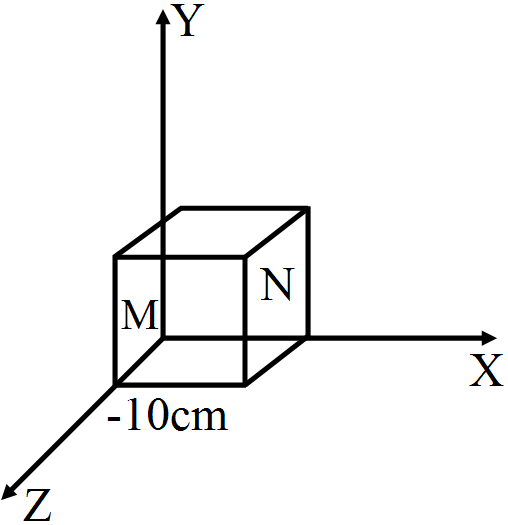
Electric field in the given figure is directed along $+X$ direction and given by $Ex = 5A_x + 2B,$ where $E$ is in $NC^{-1}$ and $x$ is in metre$, A$ and $B$ are constants with dimensions. Taking $A = 10\ NC^{-1} m^{-1}$ and $B = 5\ NC^{-1},$ calculate:
  1. The electric flux through the cube.
  1. Net charge enclosed within the cube.
An $X-$ray tube operates at $40kV.$ Suppose the electron converts $70\%$ of its energy into a photon at each collision. Find the lowest there wavelengths emitted from the tube. Neglect the energy imparted to the atom with which the electron collides.
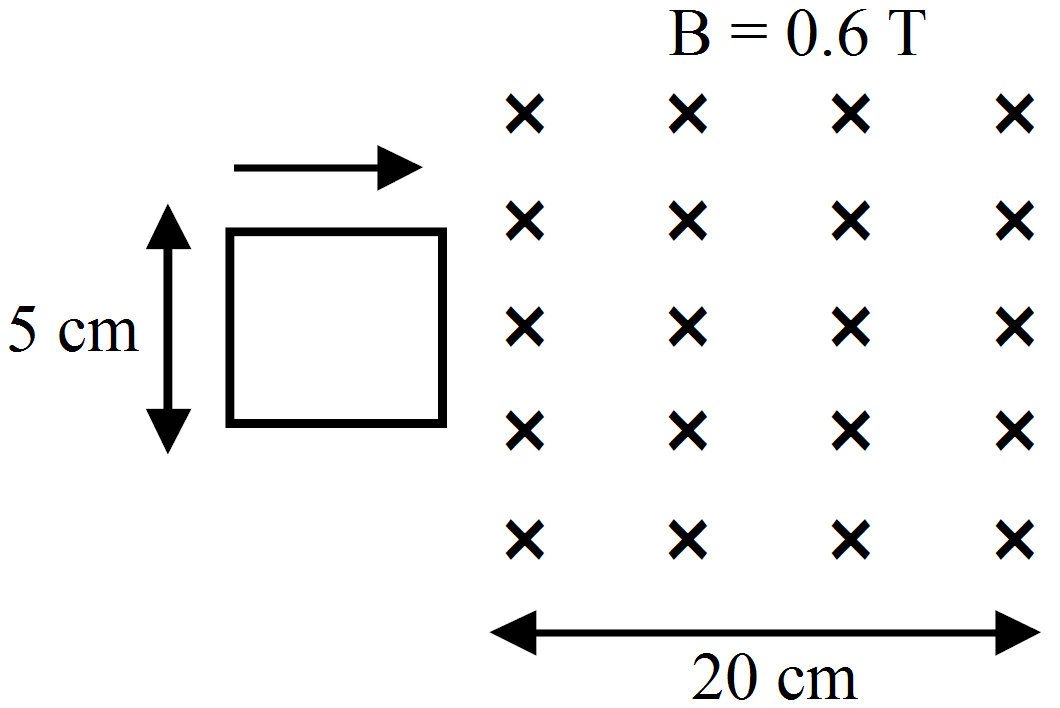
Figure shows a square loop of side 5cm being moved towards right at a constant speed of 1cm/s. The front edge enters the 20cm wide magnetic field at t = 0. Find the emf induced in the loop at:
  1. t = 2s
  2. t = 10s
  3. t = 22s
  4. t = 30s.
The two blocks in an Atwood machine have masses $2.0\ kg$ and $3.0\ kg$. Find the work done by gravity during the fourth second after the system is released from rest.
A $60W$ load is connected to the secondary of a transformer whose primary draws line voltage. If a current of $0.54A$ flows in the load, what is the current in the primary coil? Comment on the type of transformer being used.
A charge of $8 \ mC$ is located at the origin. Calculate the work done in taking a small charge of $–2 \times 10^{–9} C$ from a point $P (0, 0, 3 \ cm)$ to a point $Q (0, 4 \ cm, 0),$ via a point $R (0, 6 \ cm, 9 \ cm)$.
Assume that there is no repulsive force between the electrons in an atom but the force between positive and negative charges is given by Coulomb’s law as usual. Under such circumstances, calculate the ground state energy of a $He -$ atom.
What is rivetted galvanometer? What is the function of shunt in a galvanometer?