Question
Two circles with centres $O$ and $O′$ intersect at two points $A$ and $B$. A line $PQ$ is drawn parallel to $OO′$ through A(or B) intersecting the circles at $P$ and $Q$. Prove that $PQ = 2OO′.$

Answer

Two ciecles with centre $O$ and $O'$ intersect at two points $A$ and $B$. A line $PQ$ is drawn parallel to $OO'$ through A (or B) intersecting the circles at $P$ and $Q.$
Draw $\text{OC}\bot\text{PA}$ and $\text{O'D}\bot\text{AQ}.$
We have to prove that $PQ = 2OO'.$
Since perpendicular from the centre to a chord bisect the chord,
so $PA = 2CA ....(1)$ and $AQ = 2AD ...(2)$ Adding $(1)$ and $(2),$
we get $PA + AQ = 2CA + 2AD $
$⇒ PQ = 2(CA + AD) = 2CD$
Hence, $PQ = 2OO'$
[$\because CD$ and $OO'$ are opposite sides of a rectangle]

Need a full question paper?

Generate a complete, print-ready paper with questions like this in minutes — across 16+ boards, with answer keys.
Start Generating Free

Similar questions

Two chords AB, CD of lengths 5cm, 11cm respectively of a circle are parallel. If the distance between AB and CD is 3cm, find the radius of the circle.
In a $\triangle\text{ABC},$ D, E and F are, respectively the mid points of BC, CA and AB. If the lengths of sides AB, BC and CA are 7cm, 8cm and 9cm, respectively, find the perimeter of $\triangle\text{DEF}.$
The blood groups of $30$ students of class $VIII$ are recorded as follows:
$A, B, O, O, AB, O, A, O, B, A, O, B, A, O, O, A, AB, O, A, A, O, O, AB, B, A, O, B, A, B, O$
Represent this data in the form of a frequency distribution table. Find out which is the most common and which is the most rarest blood group among these students.
Find the volume of a conical tank with the following dimensions in liters: Height $12\ cm$, slant height $13\ cm$.
Two opposite angles of a parallelogram are $(3x - 2)^\circ $ and $(50 - x)^\circ .$ Find the measure of each angle of the parallelogram.
In a rhombus ABCD show that diagonal AC bisects $\angle\text{A}$ as well as $\angle\text{C}$ and diagonal BD bisects $\angle\text{B}$ as well as $\angle\text{D}.$
P is the mid-point of side BC of a parallelogram ABCD such that $\angle\text{BAP}=\angle\text{DAP}$ Prove that AD = 2CD.
Simplify the following products: $\Big(\frac{1}{2}\text{a}-3\text{b}\Big)\Big(3\text{b}+\frac{1}{2}\text{a}\Big)\Big(\frac{1}{4}\text{a}^2+9\text{b}^2\Big)$
If $\text{x}=2+\sqrt3,$ find the value of $\text{x}+\frac{1}{\text{x}}.$
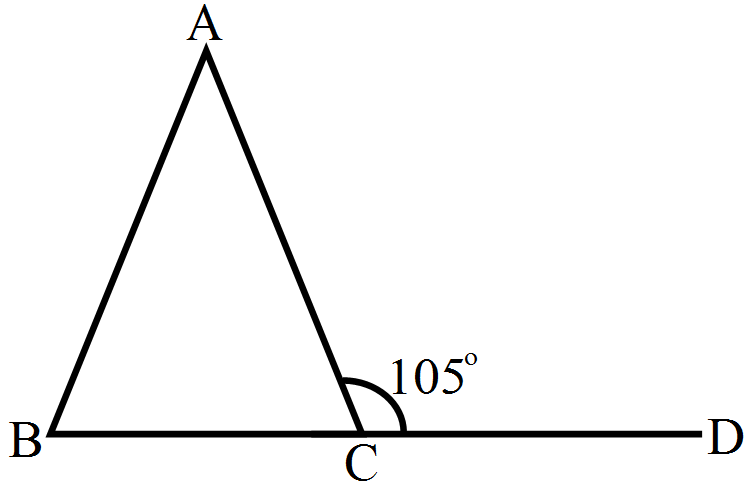
In Fig. $\text{AB}=\text{AC}$ and $\angle\text{ACD}=105^\circ,$ find $\angle\text{BAC}.$