Question
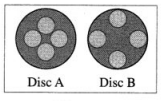
Two circular discs A and B, having the same mass, have four identical small circular discs placed on them, as shown in the diagram. They are simultaneously released from rest at the top of an inclined plane. If the discs roll down without slipping, which disc will reach the bottom first?
Image

Answer

The disc A has the smaller discs closer to the centre than disc B. Hence, the moment of inertia of disc $A\left(I_A\right)$ is less than that of disc $B\left(I_B\right)$.
[Suppose the larger discs have radius $R$, the smaller discs have mass $m$ and radius $r$, and the centre of each smaller disc on disc $\mathrm{A}$ is at a distance $\mathrm{x}$ from the centre. Then, $\mathrm{x}=\sqrt{2} \mathrm{rr}$ and, it can be shown that, $\left.I_B-I_A=4 m\left[R^2-(x-r)^2\right]>0.\right]$
Each composite disc is equivalent to a disc of the same radius $R$ and mass $M^{\prime}=M+4 m$, where $m$ is the mass of each smaller disc, but of different thicknesses.
Suppose, starting from rest, the composite discs roll down the same distance $L$ along a plane inclined at an angle $\theta$, their respective accelerations will be
$
a_{\mathrm{A}}=\frac{g \sin \theta}{1+\left(I_{\mathrm{A}} / M^{\prime} R^2\right)}, \quad a_{\mathrm{B}}=\frac{g \sin \theta}{1+\left(I_{\mathrm{B}} / M^{\prime} R^2\right)}
$
so that, the respective times taken to travel the distance $L$ are
$
\begin{aligned}
t_{\mathrm{A}} & =\sqrt{\frac{2 L}{a_{\mathrm{A}}}}=\sqrt{\frac{2 L}{g \sin \theta} \cdot\left(1+\frac{I_{\mathrm{A}}}{M^{\prime} R_2}\right)} \text { and } \\
t_{\mathrm{B}} & =\sqrt{\frac{2 L}{a_{\mathrm{B}}}}=\sqrt{\frac{2 L}{g \sin \theta} \cdot\left(1+\frac{I_{\mathrm{B}}}{M^{\prime} R_2}\right)} \\
\therefore t_{\mathrm{A}} & <t_{\mathrm{B}},
\end{aligned}
$
i.e., the disc A will reach the bottom first.

Need a full question paper?

Generate a complete, print-ready paper with questions like this in minutes — across 16+ boards, with answer keys.

Start Generating Free

Similar questions

Derive an expression for the self inductance of a narrow air $-$ cored toroid of circular cross section.
A stone of mass $1 \mathrm{~kg}$, attached at the end of a $1 \mathrm{~m}$ long string, is whirled in a horizontal circle. If the string makes an angle of $30^{\circ}$ with the vertical, calculate the centripetal force acting on the stone.
Derive an expression for the net torque on a rectangular current-carrying loop placed in a uniform magnetic field with its rotation axis perpendicular to the field.
What are the electric potentials outside and inside a charged spherical conductor in electro static equilibrium?
Two tanks of equal volume contain equal masses of oxygen and nitrogen at $127^{\circ} \mathrm{C}$. Find the ratio of
(i) the number of molecules of the gases
(ii) the pressure exerted by the gases in the two tanks. [Molar mass of oxygen $=32 \mathrm{~g} / \mathrm{mol}$,
molar mass of nitrogen $=28 \mathrm{~g} / \mathrm{mol}$ ]
In Fery's blackbody, the hole is the blackbody but not the inner coated or outer sphere alone. Explain.
State an expression for the moment of inertia of a solid sphere about its diameter. Write the expression for the corresponding radius of gyration.
When an AC source is connected to an ideal inductor show that the average power supplied by the source over a complete cycle is zero.
A dipole with its charges, -q and + q located at the points (0, -b, 0) and (0 +b, 0) is present in a uniform electric field E whose equipotential surfaces are planes parallel to the YZ planes.
(a) What is the direction of the electric field E?
(b) How much torque would the dipole experience in this field?
Compare the rates of emission of heat by a blackbody maintained at 727ºC and at 227ºC, if the black bodies are surrounded
by an enclosure (black) at 27ºC. What would be the ratio of their rates of loss of heat ?