Question
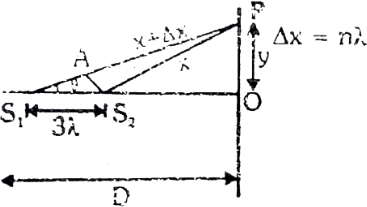
Two coherent narrow slits emitting light of wavelength $\lambda$ in the same phase are placed parallel to each other at a small separation of $3 \lambda$. The light is collected on a screen $S$ which is placed at a distance $D (>> \lambda)$ from the slits. The smallest  distance $x$ such that the $P$ is a maxima.
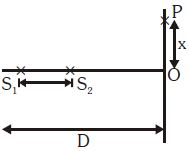
Answer

In this case path difference is $\mathrm{d} \cos \theta$

so $n \lambda=\lambda=3 \lambda \cos \theta \Rightarrow \cos \theta=\frac{1}{3}$

$\Rightarrow \frac{D}{\sqrt{D^{2}+y^{2}}}=\frac{1}{3} \Rightarrow 3 D=\sqrt{D^{2}+Y^{2}}$

$\Rightarrow y=\sqrt{8} D=2 \sqrt{2} D$

Need a full question paper?

Generate a complete, print-ready paper with questions like this in minutes — across 16+ boards, with answer keys.

Start Generating Free

Similar questions

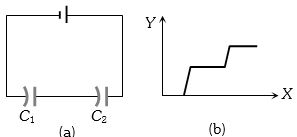
Figure $(A)$ shows two capacitors connected in series and joined to a battery. The graph in figure $(B)$ shows the variation in potential as one moves from left to right on the branch containing the capacitors, if
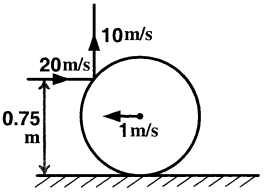
A thin ring of mass $2 \ kg$ and radius $0.5 \ m$ is rolling without slipping on a horizontal plane with velocity $1 \ m / s$. A small ball of mass $0.1 \ kg$, moving with velocity $20 \ m / s$ in the opposite direction, hits the ring at a height of $0.75 \ m$ and goes vertically up with velocity $10 \ m / s$. Immediately after the collision

$(A)$ the ring has pure rotation about its stationary $CM$.

$(B)$ the ring comes to a complete stop.

$(C)$ friction between the ring and the ground is to the left.

$(D)$ there is no friction between the ring and the ground.

An arc lamp requires a direct current of $10\ A$ at $80\ V$ to function. If it is connected to a $ 220\ V (rms ), 50\ Hz\ AC$ supply, the series inductor needed for it to work is close to :
A sample of hydrogen atom is in excited state (all the atoms). The photons emitted from this sample are made to pass through a filter through which light having wavelength greater than $800$ $nm$ can only pass. Only one type of photons are found to pass the filter. The sample's excited state initially is : [Take $hc$ = $1240 $ $eV$ $-nm$, ground state energy of hydrogen atom = $-$ $13.6$ $eV$.]
As an electron makes a transition from an excited state to the ground state of a hydrogen - like atom/ion:
A particle is executing the motion $x = A\cos (\omega \,t - \theta )$. The maximum velocity of the particle is
If $\overrightarrow {\rm A} = 2\hat i + 3\hat j - \hat k$ and $\overrightarrow B = - \hat i + 3\hat j + 4\hat k$ a unit vector perpendicular to both $\overrightarrow A $ and $\overrightarrow B $ will be
The forward biased diode connection is
In an $\alpha -$ decay the Kinetic energy of $\alpha$ particle is $48 \,MeV$ and $Q-$ value of the reaction is $50 \,MeV.$ The mass number of the mother nucleus is : (Assume that daughter nucleus is in ground state)
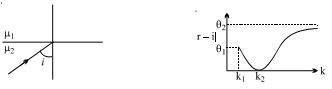
The figure shows a ray incident at an angle $i = \pi /3$. If the plot drawn shown the variation of $| r - i |$ versus $\frac{{{\mu _1}}}{{{\mu _2}}} = k,$ $(r =$ angle of refraction)