Question
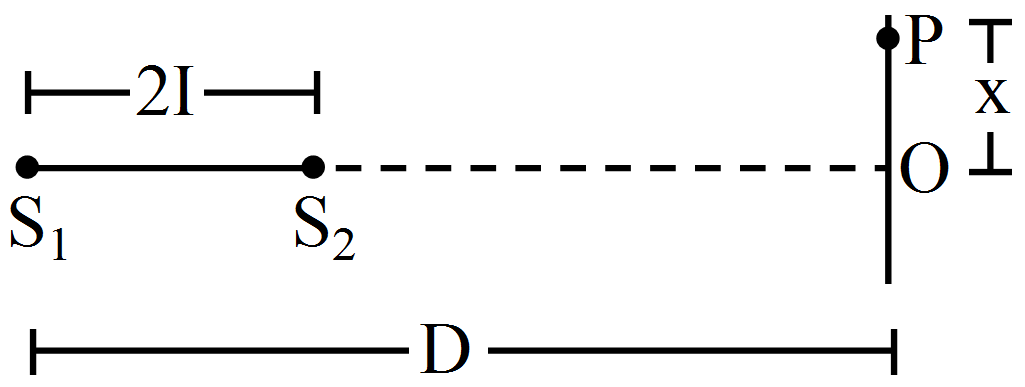
Two coherent narrow slits emitting sound of wavelength $\lambda$ in the same phase are placed parallel to each other at a small separation of $2\lambda.$ The sound is detected by moving a detector on the screen $\sum$ at a distance $\text{D}(>>\lambda)$ from the slit S1 as shown in figure. Find the distance x such that the intensity at P is equal to the intensity at 0.
Answer

Given:

S1 & S2 are in the same phase. At O, there will be maximum intensity.

There will be maximum intensity at P.

From the(in questions):

$\triangle\text{S}_1\text{PO}$ and $\triangle\text{S}_2\text{PO}$ are right-angled triangle

So, $(\text{S}_1\text{P})^2-(\text{S}_2\text{P})^2$

$=\big[\text{D}^2+\text{x}^2\big]-\Big[(\text{D}-2\lambda)^2+\text{x}^2\Big]^2$

$=4\lambda\text{D}+4\lambda^2=4\lambda\text{D}$

$\Big(\lambda^2$ is small and can be neglected$\Big)$

$\Rightarrow(\text{S}_1\text{P}+\text{S}_2\text{P})(\text{S}_1\text{P}-\text{S}_2\text{P})=4\lambda\text{D}$

$\Rightarrow(\text{S}_1\text{P}-\text{S}_2\text{P})=\frac{4\lambda\text{D}}{(\text{S}_1\text{P}+\text{S}_2\text{P})}$

$\Rightarrow\text{S}_1\text{P}-\text{S}_2\text{P}=\frac{4\lambda\text{D}}{2\sqrt{\text{x}^2+\text{D}^2}}$

For constructive interference, path difference $=\text{n}^\lambda$

So, $\text{S}_1\text{P}-\text{S}_2\text{P}=\frac{4\lambda\text{D}}{2\sqrt{\text{x}^2+\text{D}^2}}=\text{n}\lambda$

$\Rightarrow\frac{2\text{D}}{\sqrt{\text{x}^2+\text{D}^2}}=\text{n}$

$\Rightarrow\text{n}^2\big(\text{x}^2+\text{D}^2\big)=4\text{D}^2$

$\Rightarrow\text{n}^2\text{x}^2+\text{n}^2\text{D}^2=4\text{D}^2$

$\Rightarrow\text{n}^2\text{x}^2=4\text{D}^2-\text{n}^2\text{D}^2$

$\Rightarrow\text{n}^2\text{x}^2=\text{D}^2(4-\text{n}^2)$

$\Rightarrow\text{x}=\frac{\text{D}}{\text{n}}\sqrt{4-\text{n}^2}$

When n = 1,

$\text{x}=\sqrt{3}\text{D}$ (1st order).

When n = 2,

$\text{x}=0$ (2nd order).

So when $\text{x}=\sqrt{3}\text{D},$ the intensity at P is equal to the intensity at O.

Need a full question paper?

Generate a complete, print-ready paper with questions like this in minutes — across 16+ boards, with answer keys.

Start Generating Free

Similar questions

Which is greater; the angular velocity of the hour hand of a watch or angular velocity of earth around its own axis?
A constant force of 2.50N accelerates a stationary particle of mass 15g through a displacement of 2.50m. Find the work done and the average power delivered.
Design a logical circuit using AND, OR and NOT gates to evaluate $\text{A}\overline{\text{BC}}+\text{B}\overline{\text{CA}}.$
Briefly explain the cause of special cylindrical shape of bullets.
Iceberg floats in water with part of it submerged. What is the fraction of the volume of iceberg submerged if the density of ice is $\rho_\text{i}=0.917\text{g cm}^{-3}?$
Water near the bed of a deep river is quiet while that near the surface flows. Give reasons.
The radius of the Earth is 6.37 × 10⁶ m and its mass is 5.975 × 1024 kg. Find the Earth's average density to appropriate significant figures.
Four persons K, L, M and N start from the vertices of a square of side 'a', simultaneously and move towards the neighbour in order always with the same speed of v. When and where do they meet?
A particle is projected with a speed u at an angle $\theta$ with the horizontal. Consider a small part of its path near the highest position and take it approximately to be a circular arc. What is the radius of this circle? This radius is called the radius of curvature of the curve at the point.
Explain why:
Two bodies at different temperatures T1 and T2 if brought in thermal contact do not necessarily settle to the mean temperature (T1 + T2 )/2.