MCQ
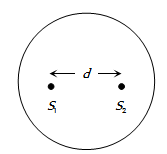
Two coherent sources separated by distance d are radiating in phase having wavelength l. A detector moves in a big circle around the two sources in the plane of the two sources. The angular position of n = 4 interference maxima is given as
  • A
     $\sin ^{-1} \frac{ n \lambda}{ d }$
  •  $\cos ^{-1} \frac{4 \lambda}{d}$
  • C
     $\tan ^{-1} \frac{d}{4 \lambda}$
  • D
     $\cos ^{-1} \frac{\lambda}{4 d}$

Answer

Correct option: B.
 $\cos ^{-1} \frac{4 \lambda}{d}$
$\cos ^{-1} \frac{4 \lambda}{d}$

Need a full question paper?

Generate a complete, print-ready paper with questions like this in minutes — across 16+ boards, with answer keys.

Start Generating Free

Similar questions

The two light beams having intensities I and 9I interfere to produce a fringe pattern on a screen. The phase difference between the beams is $\frac{\pi}{2}$ at point $P$ and $\pi$ at point $Q$. Then the difference between the resultant intensities at $P$ and $Q$ will be.......$I$
A charged particle having drift velocity of $7.5 \times 10^{-4}\, ms ^{-1}$ is an electric field of $3 \times 10^{-10}\, Vm ^{-1}$ has a mobility in $m ^{2} V ^{-1} s ^{-1}$ of 
For an isotropic medium $B$, $\mu$,$ H $ and $M$  are related as (where $B,\,\,{\mu _0},\,\,H$ and M have their usual meaning in the context of magnetic material
A material '$B$' has twice the specific resistance of '$A$'. A circular wire made of '$B$' has twice the diameter ofa wire made of '$A$'. then for the two wires to have the same resistance, the ratio $\frac{{{l_B}}}{{{l_A}}}$ of their respective lengths must be
The area of its cross-section is $1.2 \times {10^{ - 3}}{m^2}$. Around its central section, a coil of $300$ turns is wound. If an initial current of $2A$ in the solenoid is reversed in $0.25\, sec$, then the $e.m.f$. induced in the coil is
Dispersion can take place for
Copper and germanium are cooled from room temperature to 30 K. In this process, the resistance:
The tail of the comet is due to
As compared to ${ }^{12} \mathrm{C}$ atom, ${ }^{14} \mathrm{C}$ atom has:
Two identical bar magnets are fixed with their centres at a distance $d$ apart. A stationary charge $Q$ is placed at $P$ in between the gap of the two magnets at a distance $D$ from the center $O$ as shown in the figure. The force on the charge $Q$ is