Question
Two coherent waves of equal amplitude produce interference pattern in Young’s double slit experiment. What is the ratio of intensity at a point where phase difference is $\frac{\pi}{2}$ to intensity at centre?

Answer

$\text{I}_\frac{\pi}{2}=\text{a}^2_1+\text{a}^2_2+\text{2a}_1\text{a}_2\cos\varphi$
$=\text{a}^2+\text{a}^2+2\text{a}^2\cos\frac{\pi}{2}=2\text{a}^2$
$\text{I}_\max=(\text{a}_2+\text{a}_2)^2=(\text{a}+\text{a})^2=4\text{a}^2$
$\therefore\frac{\text{I}_\frac{\pi}{2}}{\text{I}_\max}=\frac{2\text{a}^2}{\text{4a}^2}=\frac{1}{2}.$

Need a full question paper?

Generate a complete, print-ready paper with questions like this in minutes — across 16+ boards, with answer keys.
Start Generating Free

Similar questions

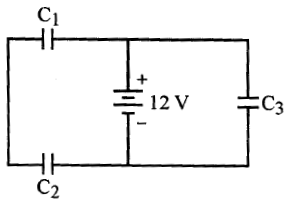
Three identical capacitors $C_1, C_2$ and $C_3$ of capacitance 6 µF each are connected to a 12 V battery as shown.
Find:
  1. charge on each capacitor.
  2. equivalent capacitance of the network.
  3. energy stored in the network of capacitors.
A small telescope has an objective lens of focal length 140 cm and an eyepiece of focal length 5.0 cm. What is the magnifying power of the telescope for viewing distant objects when,
  1. the telescope is in normal adjustment (i.e., when the final image is at infinity)?
  2. the final image is formed at the least distance of distinct vision (25 cm)?
A parallel-plate capacitor of plate-area A and plate separation d is joined to a battery of emf $\in$ and internal resistance R at t = 0. Consider a plane surface of area $\frac{\text{A}}{2}$ parallel to the plates and situated symmetrically between them. Find the displacement current through this surface as a function of time.
There are two sources of light A and B. The wavelength of light emitted from A is from $8000\mathring{\text{A}}$ to $11000\mathring{\text{A}},$ while that from B is from $3000\mathring{\text{A}}$ to $6000\mathring{\text{A}}.$ The intensity of A is 4 times that of B. But when light of A falls on metal, photoelectrons are not emitted whereas light of B can eject photoelectrons from the same metal. Explain its reason.
  1. Write the expression for the speed of light in a material medium of relative permittivity $\varepsilon_\text{r}$ and relative magnetic permeability $\mu_\text{r}.$
  2. Write the wavelength range and name of the electromagnetic waves which are used in:
  1. Radar systems for aircraft navigation,
  2. Earth satellites to observe the growth of the crops.
Define the terms (i) drift velocity, (ii) relaxation time.
A conductor of length L is connected to a dc source of emf ε. If this conductor is replaced by another conductor of same material and same area of cross-section but of length 3L, how will the drift velocity change?
The potential difference across a resistor ‘r’ carrying current ‘I’ is Ir.
  1. Now if the potential difference across ‘r’ is measured using a voltmeter of resistance ‘RV’, show that the reading of voltmeter is less than the true value
  2. Find the percentage error in measuring the potential difference by a voltmeter.
  3. At what value of RV, does the voltmeter measures the true potential difference?
Name the following constituent radiations of electromagnetic spectrum which
  1. produce intense heating effect.
  2. is absorbed by the ozone layer in the atmosphere.
  3. is used for studying crystal structure.
Write one more application forr each of these radiations.

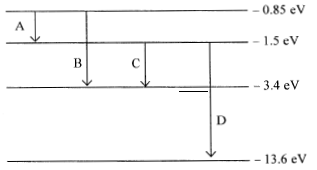
The energy level diagram of an element is given below. Identify, by doing necessary calculations, which transition corresponds to the emission of a spectral line of wavelength 102.7 nm.
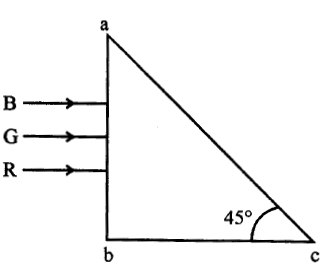
Three light rays red (R), green (G) and blue (B) are incident on a right-angled prism ‘abc’ at face ‘ab’. The refractive indices of the material of the prism for red, green and blue wavelengths are 1.39, 1.44 and 1.47 respectively. Out of the three which colour ray will emerge out of face ‘ac’? Justify your answer. Trace the path of these rays after passing through face ‘ab’.