Question
Two conducting plates X and Y, each having large surface area A (on one side), are placed parallel to each other as shown in figure. The plate X is given a charge Q whereas the other is neutral. Find:
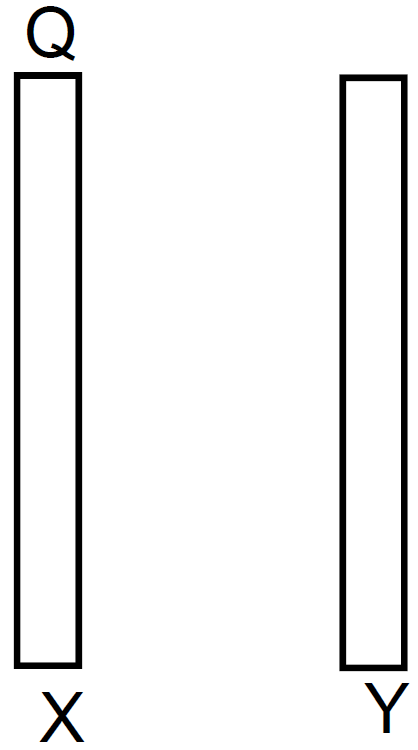
  1. The surface charge density at the inner surface of the plate X.
  2. The electric field at a point to the left of the plates.
  3. The electric field at a point in between the plates.
  4. The electric field at a point to the right of the plates.
Answer

  1. Given that the charge present on the plate is Q. The other plate will get the same charge Q due to convection.
Let the surface charge densities on both sides of the plate be $\sigma_1$ and $\sigma_2.$
Now, electric field due to a plate,
$\text{E}=\frac{\sigma}{2\epsilon_0}$
So, the magnitudes of the electric fields due to this plate on each side $=\frac{\sigma_1}{2\epsilon_0}$ and $\frac{\sigma_2}{2\epsilon_0}$
The plate has two sides, each of area A. So, the net charge given to the plate will be equally distributed on both the sides.This implies that the charge developed on each side will be:
$\text{q}_1=\text{q}_2=\frac{\text{Q}}{2}$
This implies that the net surface charge density on each side $=\frac{\text{Q}}{2\text{A}}$
  1. Electric field to the left of the plates
On the left side of the plate surface, charge density,
$\sigma=\frac{\text{Q}}{2\text{A}}$
Hence, electric field $=\frac{\text{Q}}{2\text{A}\epsilon_0}$
This must be directed towards the left, as 'X' is the positively-charged plate.
  1. Here, the charged plate 'X' acts as the only source of electric field, with positive in the inner side. Plate Y is neutral. So, a negative charge will be induced on its inner side. 'Y' attracts the charged particle towards itself. So, the middle portion E is towards the right and is equal to $\frac{\text{Q}}{2\text{A}\epsilon_0}.$
  2. Similarly for the extreme right, the outer side of plate 'Y' acts as positive and hence it repels to the right with $\text{E}=\frac{\text{Q}}{2\text{A}\epsilon_0}.$

Need a full question paper?

Generate a complete, print-ready paper with questions like this in minutes — across 16+ boards, with answer keys.

Start Generating Free

Similar questions

Draw a phasor diagram for series LCR circuit joined with ac voltage source and obtain an expression for impedance of the circuit.
Explain the Function of a $n-p-n$ transistor as a switch with necessary circuit diagram.
A bulb with rating $250V, 100W$ is connected to a power supply of $220V$ situated $10m$ away using a copper wire of area of cross$-$section $5\ mm^2.$ How much power will be consumed by the connecting wires? Resistivity of copper $1.7\times10^{-8}\Omega-\text{m}$.
What do you mean by angle of polarisation? Prove that reflected and refracted rays are mutually perpendicular for a ray incident at angle of polarisation.
Draw a labelled diagram of a moving coil galvanometer. State the principle on which it works.Deduce an expression for the torque acting on a rectangular current carrying loop kept in a uniform magnetic field. Write two factors on which the current sensitivity of a moving coil galvanometer depend.
An infinite ladder is constructed with $1\Omega$ and $2\Omega$ resistors, as shown in the figure. (a) Find the effective resistance between the points A and B. (b) Find the current that passes through the $2\Omega$ resistor nearest to the battery.
The work function of caesium metal is 2.14 eV. When light of frequency $6 \times 10^{14}$ Hz is incident on the metal surface photo-emission of electrons occurs. What is the
(a) Maximum kinetic energy of emitted electrons
(b) Stopping potential, and
(c) Maximum speed of the emitted photo-electrons?
A mass $m = 50g$ is dropped on a vertical spring of spring constant $500\ N/m$ from a height $h = 10\ cm$ as shown in figure. The mass sticks to the spring and executes simple harmonic oscillations after that. A concave mirror of focal length $12\ cm$ facing the mass is fixed with its principal axis coinciding with the line of motion of the mass, its pole being at a distance of $30\ cm$ from the free end of the spring. Find the length in which the image of the mass oscillates.
There are two current carrying planar coils made each from identical wires of length $L. C_1$ is circular $($radius $R )$ and $C_2$ is square $($side a$)$. They are so constructed that they have same frequency of oscillation when they are placed in the same uniform $B$ and carry the same current. Find a in terms of $R$.
Figure shows a square loop of side 5cm being moved towards right at a constant speed of 1cm/s. The front edge enters the 20cm wide magnetic field at t = 0. Find the emf induced in the loop at:
  1. t = 2s
  2. t = 10s
  3. t = 22s
  4. t = 30s.