Question
Two conducting plates X and Y, each having large surface area A (on one side), are placed parallel to each other as shown in figure. The plate X is given a charge Q whereas the other is neutral. Find:
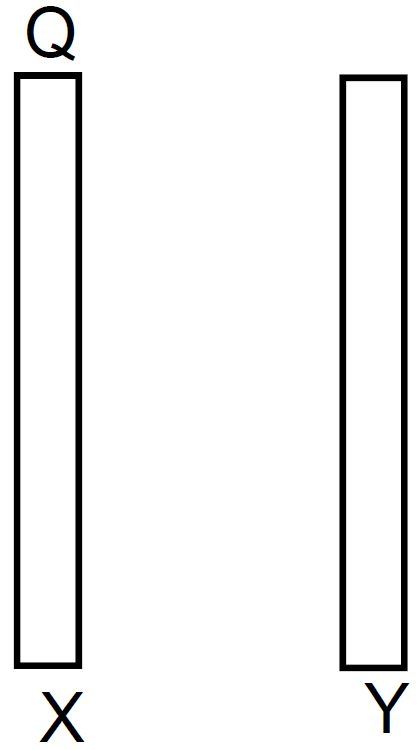
  1. The surface charge density at the inner surface of the plate X.
  2. The electric field at a point to the left of the plates.
  3. The electric field at a point in between the plates.
  4. The electric field at a point to the right of the plates.

Answer

  1. Given that the charge present on the plate is Q. The other plate will get the same charge Q due to convection.
Let the surface charge densities on both sides of the plate be $\sigma_1$ and $\sigma_2.$

Now, electric field due to a plate,

$\text{E}=\frac{\sigma}{2\in_0}$

So, the magnitudes of the electric fields due to this plate on each side $=\frac{\sigma_1}{2\in_0}$ and $\frac{\sigma_2}{2\in_0}$

The plate has two sides, each of area A. So, the net charge given to the plate will be equally distributed on both the sides.This implies that the charge developed on each side will be:

$\text{q}_1=\text{q}_2=\frac{\text{Q}}{2}$

This implies that the net surface charge density on each side $=\frac{\text{Q}}{2\text{A}}$
  1. Electric field to the left of the plates
On the left side of the plate surface, charge density,

$\sigma=\frac{\text{Q}}{2\text{A}}$

Hence, electric field $=\frac{\text{Q}}{2\text{A}\in_0}$

This must be directed towards the left, as 'X' is the positively-charged plate.
  1. Here, the charged plate 'X' acts as the only source of electric field, with positive in the inner side. Plate Y is neutral. So, a negative charge will be induced on its inner side. 'Y' attracts the charged particle towards itself. So, the middle portion E is towards the right and is equal to $\frac{\text{Q}}{2\text{A}\in_0}.$
  2. Similarly for the extreme right, the outer side of plate 'Y' acts as positive and hence it repels to the right with $\text{E}=\frac{\text{Q}}{2\text{A}\in_0}.$

Need a full question paper?

Generate a complete, print-ready paper with questions like this in minutes — across 16+ boards, with answer keys.

Start Generating Free

Similar questions

A pin of length $2.00cm$ is placed perpendicular to the principal axis of a converging lens. An inverted image of size $1.00cm$ is formed at a distance of $40.0cm$ from the pin. Find the focal length of the lens and its distance from the pin.
Establish the following vector inequalities geometrically or otherwise: $|\text{a}-\text{b}|\ge||\text{a}|-|\text{b}||$When does the equality sign above apply?
A particle executes S.H.M of time period $10s$. The displacement at any instant is given by the relation $\text{x}=10\sin\omega\text{t}$ Find
  1. Velocity of the body 2s after it passes through the mean position and
  2. The acceleration 2s after it passes the mean position (Amplitude is given in cm).
The current−voltage characteristic of an ideal p-n junction diode is given by $\text{i}=\text{i}_0\Big(\text{e}^{\frac{\text{eV}}{\text{kT}}}-1\Big)$ where, the drift current $i_0$ equals $10\mu\text{A}.$ Take the temperature T to be 300K.
  1. Find the voltage $V_0$ for which $\text{e}^{\frac{\text{eV}}{\text{KT}}}=100.$ One can neglect the term 1 for voltages greater than this value.
  2. Find an expression for the dynamic resistance of the diode as a function of $V$ for $V > V_0$.
  3. Find the voltage for which the dynamic resistance is $0.2\Omega.$
What are the arithmatic operations of significant figures. What are the rules for rounding off a number? Explain each rule with example.
An ornament weighing $36g$ in air, weighs only $34g$ in water. Assuming that some copper is mixed with gold to prepare the ornament, find the amount of copper in it. Specific gravity of gold is $19.3$ and that of copper is $8.9$.
The oxygen molecule has a mass of $5.30 \times 10^{-26}kg$ and a moment of inertia of $1.94 \times 10^{-46}kgm^2$ about an axis through its centre perpendicular to the lines joining the two atoms. Suppose the mean speed of such a molecule in a gas is 500m/s and that its kinetic energy of rotation is two thirds of its kinetic energy of translation. Find the average angular velocity of the molecule.
A sphere of a radius 10cm weighs 1kg, calculate the moment of inertia.
  1. About the diameter.
  2. About the tangent.
A small block of mass m and a concave mirror of radius R fitted with a stand lie on a smooth horizontal table with a separation d between them. The mirror together with its stand has a mass m. The block is pushed at $t = 0$ towards the mirror so that it starts moving towards the mirror at a constant speed V and collides with it. The collision is perfectly elastic. Find the velocity of the image:
  1. At a time $\text{t}<\frac{\text{d}}{\text{V}}$
  2. At a time $\text{t}>\frac{\text{d}}{\text{V}}.$
Suppose all the electrons of 100g water are lumped together to form a negatively charged particle and all the nuclei are lumped together to form a positively charged particle. If these two particles are placed 10.0cm away from each other, find the force of attraction between them. Compare it with your weight.