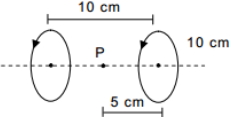
- A$\frac{50 \mu_{0}}{\sqrt{5}} T$
- B$\frac{28 \mu_{0}}{\sqrt{5}} T$
- ✓$\frac{56 \mu_{0}}{\sqrt{5}} T$
- D$\frac{56 \mu_{0}}{\sqrt{3}} T$
$B_{1}=B_{2}$
At point $P$
The magnetic field will be in same direction by both coils,
$B=B_{1}+B_{2}$
$=B_{1}+B_{1}$
$=2 B_{1}$
The magnetic field at point $P$ is,
$B=2\left(\frac{\mu_{0} i r^{2}}{2\left(r^{2}+n^{2}\right)^{3 / 2}}\right)$
$=\frac{\mu_{0} i r^{2}}{2\left(r^{2}+n^{2}\right)^{3 / 2}}$
Substitute the values in the above equation.
$B=\frac{\mu_{0} \times \frac{7}{2} \times 0.1^{2}}{2\left(0.1^{2}+0.05^{2}\right)^{3 / 2}}$
$=\frac{56 \mu_{0}}{\sqrt{5}} T$
Generate a complete, print-ready paper with questions like this in minutes — across 16+ boards, with answer keys.

($A$) The refractive index of the lens is $2.5$
($B$) The radius of curvature of the convex surface is $45 \mathrm{~cm}$
($C$) The faint image is erect and real
($D$) The focal length of the lens is $20 \mathrm{~cm}$