MCQ
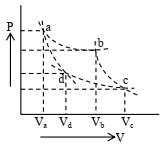
Two different adiabatic paths for the same gas intersect two isothermal curves as shown in$P-V$ diagram. The relation between the ratio $\frac{V_a}{V_d}$ and the ratio $\frac{V_b}{V_c}$ is:
  • A
    $\frac{V_a}{V_d}=\left(\frac{V_b}{V_c}\right)^{-1}$
  • B
    $\frac{V_a}{V_d} \neq \frac{V_b}{V_c}$
  • $\frac{V_a}{V_d}=\frac{V_b}{V_c}$
  • D
    $\frac{V_a}{V_d}=\left(\frac{V_b}{V_c}\right)^2$

Answer

Correct option: C.
$\frac{V_a}{V_d}=\frac{V_b}{V_c}$
c
For adiabatic process

$\mathrm{TV}^{\gamma-1}=\text { constant }$

$\mathrm{T}_{\mathrm{a}} \cdot \mathrm{V}_{\mathrm{a}}^{\gamma-1}=\mathrm{T}_{\mathrm{d}} \cdot \mathrm{V}_{\mathrm{d}}^{\gamma-1}$

$\left(\frac{\mathrm{V}_{\mathrm{a}}}{\mathrm{V}_{\mathrm{d}}}\right)^{\gamma-1}=\frac{\mathrm{T}_{\mathrm{d}}}{\mathrm{T}_{\mathrm{a}}}$

$\mathrm{T}_{\mathrm{b}} \cdot \mathrm{V}_{\mathrm{b}}^{\gamma-1}=\mathrm{T}_{\mathrm{c}} \cdot \mathrm{V}_{\mathrm{c}}^{\gamma-1}$

$\left(\frac{\mathrm{V}_{\mathrm{b}}}{\mathrm{V}_{\mathrm{c}}}\right)^{\gamma-1}=\frac{\mathrm{T}_{\mathrm{c}}}{\mathrm{T}_{\mathrm{b}}}$

$\mathrm{T}_{\mathrm{b}} \cdot \mathrm{V}_{\mathrm{b}}^{\gamma-1}=\mathrm{T}_{\mathrm{c}} \cdot \mathrm{V}_{\mathrm{c}}^{\gamma-1}$

$\left(\frac{\mathrm{V}_{\mathrm{b}}}{\mathrm{V}_{\mathrm{c}}}\right)^{\gamma-1}=\frac{\mathrm{T}_{\mathrm{c}}}{\mathrm{T}_{\mathrm{b}}}$

$\frac{\mathrm{V}_{\mathrm{a}}}{\mathrm{V}_{\mathrm{d}}}=\frac{\mathrm{V}_{\mathrm{b}}}{\mathrm{V}_{\mathrm{c}}} \quad\left(\begin{array}{r}\because \mathrm{T}_{\mathrm{d}}=\mathrm{T}_{\mathrm{c}} \\ \mathrm{T}_{\mathrm{a}}=\mathrm{T}_{\mathrm{b}}\end{array}\right)$
Need a full question paper?

Generate a complete, print-ready paper with questions like this in minutes — across 16+ boards, with answer keys.

Start Generating Free

Similar questions

A system is provided with $200 \,cal$ of heat and the work done by the system on the surrounding is $40 \,J$. Then its internal energy
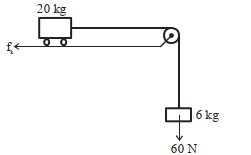
Consider a block and trolley system as shown in figure. If the coefficient of kinetic friction between the trolley and the surface is $0.04$ , the acceleration of the system in $\mathrm{ms}^{-2}$ is :

(Consider that the string is massless and unstretchable and the pulley is also massless and frictionless):

A thin rod of length $41$ and mass $4\,m$ is bent at the points as shown in figure. What is the moment of inertia of the rod about the axis passes through point $O$ and perpendicular to the plane of paper?
Karman line is a theoretical construct that separates the earth's atmosphere from outer space. It is defined to be the height at which the lift on an aircraft flying at the speed of a polar satellite $(8 \,km / s )$ is equal to its weight. Taking a fighter aircraft of wing area $30 \,m ^2$, and mass $7500 \,kg$, the height of the Karman line above the ground will be in the range .............. $km$ (assume the density of air at height $h$ above ground to be $\rho( h )=1.2 e ^{\frac{ h }{10}} \,kg / m ^3$ where $h$ is in $km$ and the lift force to be $\frac{1}{2} \rho v^2 A$, where $v$ is the speed of the aircraft and $A$ its wing area).
The wave generated from up and down jerk given to the string or by up and down motion of the piston at end of the pipe is:
A pendulum of length $2\,m$ lift at $P$. When it reaches $Q$, it losses $10\%$ of its total energy due to air resistance. The velocity at $Q$ is .... $m/sec$
The graph below shows the variation of a force $F$ with time $t$ on a body which is moving in a straight line. Dependence of force on time is $F \propto t^{n}$. Initially body is at rest. If the speed of the object is $2 \,m / s$ at $3 \,s$, then the speed at $4 \,s$ will be approximately (in $m / s$ )
A particle of mass ${m_1}$ is moving with a velocity ${v_1}$and another particle of mass ${m_2}$is moving with a velocity ${v_2}$. Both of them have the same momentum but their different kinetic energies are ${E_1}$and ${E_2}$respectively. If ${m_1} > {m_2}$ then
Planetary system in the solar system describes
A train is moving towards east and a car is along north, both with same speed. The observed direction of car to the passenger in the train is