Question
Two different dice are thrown together. Find the probability that the numbers obtained
$(i)$ have a sum less than $7$
$(ii)$ have a product less than $16$
$(iii)$ is a doublet of odd numbers.

Answer

We know that the total number of outcome when two dice are thrown to gether is $36$
$(i)$ Have a sum less than $7$
The favourable outcomes are
$=\{(1,1),(1,2),(1,3),(1,4),(1,5),(2,1),$
$(2,2),(2,3),(2,4),(3,1),(3,2),(3,3),$
$(4,1),(4,2),(5,1)\}$
Number of favourable outcomes $=15$
So, probability of getting a sum less than $7$
$=\frac{\text { Number of favourable outcomes }}{\text { Total number of outcomes }}=\frac{15}{36}$
$=\frac{5}{12}$
$(ii)$ Have a product less than $16 $
The favourable outcomes are
$=\{(1,1),(1,2),(1,3),(1,4),(1,5),(1,6),(2,1),$
$(2,2),(2,3),(2,4),(2,5),(2,6),(3,1),(3,2),$
$(3,3),(3,4),(3,5),(4,1),(4,2),(4,3),(5,1),$
$(5,2),(5,3),(6,1),(6,2)\}$
Number of favourable outcomes $=25$
So, probability will be
$=\frac{\text { Number of favourable outcomes }}{\text { Total number of outcomes }}=\frac{25}{36}$
$(iii) A$ doublet of odd numbers.
The favourable outcomes are
$=\{(1,1),(3,3),(5,5)\}$
Number of favourable outcomes $=3$
So, probability will be
$=\frac{\text { Number of favourable outcomes }}{\text { Total number of outcomes }}=\frac{3}{36}$
$=\frac{1}{12}$

Need a full question paper?

Generate a complete, print-ready paper with questions like this in minutes — across 16+ boards, with answer keys.
Start Generating Free

Similar questions

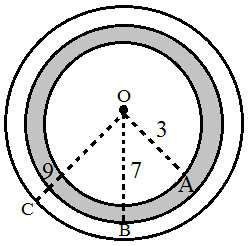
A target shown in the figure consists of three concentric circles of radii 3, 7 and 9cm respectively. A dart is thrown and lands on the target. What is the probability that the dart will land on the shaded region?
The length of a chain used as the bounary of a semicircular park is 108m. Find the area of the park $\Big[\text{Use }\pi=\frac{22}{7}\Big]$
In the following figure, OACB is a quadrant of a circle with centre O and radius 3.5cm. If OD = 2cm, find the area of the: (i) Quadrant OACB (ii) Shaded region.
If $\tan \theta+\frac{1}{\tan \theta}=2$, find the value of $\tan ^2 \theta+\frac{1}{\tan ^2 \theta}$
Prove that the points $(7,10),(-2,5)$ and $(3,-4)$ are the vertices of an isosceles right triangle.
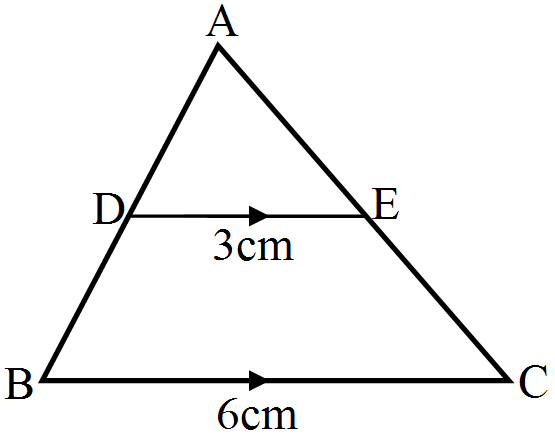
In the given figure, DE || BC. If DE = 3cm, BC = 6cm and $\text{ar}(\triangle\text{ADE})=15\text{cm}^2,$ find the area of $\triangle\text{ABC}.$
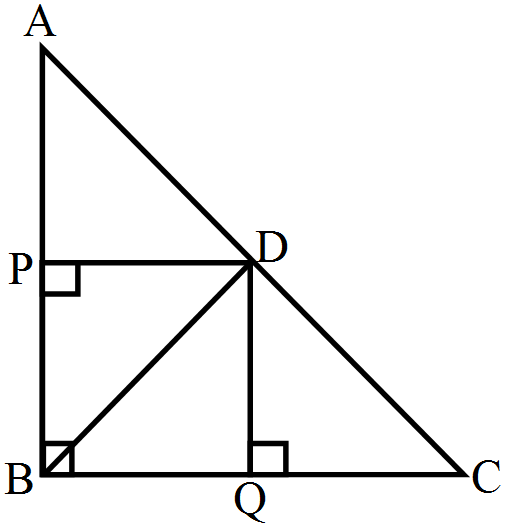
In a right triangle ABC, right-angled at B, D is a point on hypotenuse such that $\text{BD}\perp\text{AC}.$ If $\text{DP}\perp\text{AB}$ and $\text{DQ}\perp\text{BC}$ then prove that.
  1. $\text{DQ}^2=\text{DP}.\text{DQ}$
  2. $\text{DP}^2=\text{DQ}.\text{AP}$
If $\alpha$ and $\beta$ are zeroes of a polynomial $6 x^2-5 x +1$ then form a quadratic polynomial whose zeroes are $\alpha^2$ and $\beta^2$.
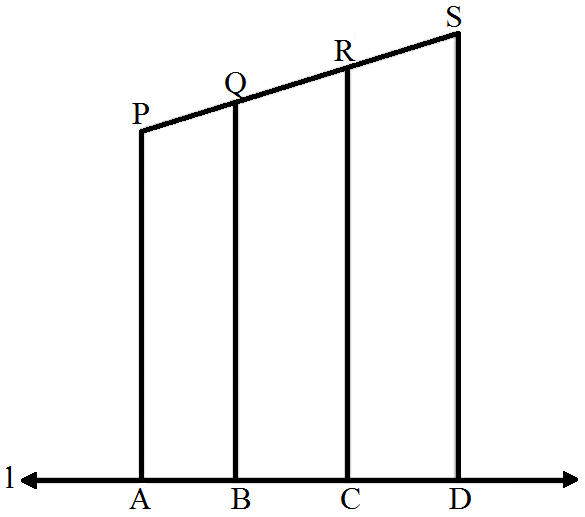
In the given figure, each of PA, QB, RC and SD is perpendicular to l. If AB = 6cm, BC = 9cm, CD = 12cm and PS = 36cm, then determine PQ, QR and RS.
A spherical shell of lead, whose external diameter is $18\ cm$, is melted and recast into a right circular cylinder, whose height is $8\ cm$ and diameter $12\ cm$. Determine the internal diameter of the shell.