Question
Two elements A and B form compounds having formula AB2 and AB4. When dissolved in 20 g of benzene $\left( C _6 H _6\right), 1 g$ of $AB _2$ lowers the freezing point by 2.3 K whereas 1.0 g of AB4 lowers it by 1.3 K. The molar depression constant for benzene is 5.1 K kg mol-1. Calculate atomic masses of A and B.
Answer

Freezing point depression :
$\Delta T _{ f }=\frac{ K _{ f } \times w_2 \times 1000}{ M _2 \times w_1}$
Molar mass $\left( M _2\right)=\frac{ K _{ f } \times w_2 \times 1000}{\Delta T_{ f } \times w_1}$
$ M _2= M _{ AB _2}=  \text { Molar mass of } AB _2=\text { ? } $
$ K _{ f }=5.1$ $K$ $kg$ $mol ^{-1} $
$ w_2=1 g, w_1=20 g, \Delta T _{ f }=2.3 K $
$ M _{ AB _2}=\frac{5.1 \times 1 \times 1000}{2.3 \times 20}=110.869 $
$ M _{ AB _2}=110.87$ $g mol ^{-1}$
Similarly, molar mass of AB4
$ M _{ AB _4}  =\frac{ K _{ f } \times w_2 \times 1000}{\Delta T_{ f } \times w_1} $
$\Delta T_{ f }  =1.3 K $
$M _{ AB _4}  =\frac{5.1 \times 1 \times 1000}{1.3 \times 20}=196.15 $
$ =196.15$ $g mol ^{-1}$
Let x and y be atomic masses of A and B respectively, Then
$M _{ AB _2}=x+2 y$
$110.87=x+2 y \quad \quad \ldots \ldots(1)$
$M _{ AB _4}=x+4 y$
$196.15=x+4 y$$\quad \quad \ldots \ldots(2)$
On substracting equation (1) from equation (2),
$ 196.15-110.87  =2 y $
$85.28  =2 y $
$y  =42.64 u$
On putting value of y in equation (1),
$ 110.87  =x+2 \times 42.64 $
$110.87  =x+85.28 $
$x  =110.87-85.28 $
$x  =25.59 u$
Hence, atomic mass of A = 25.59 u
atomic mass of B = 42.64 u

Need a full question paper?

Generate a complete, print-ready paper with questions like this in minutes — across 16+ boards, with answer keys.

Start Generating Free

Similar questions

  1. Differentiate between molarity and molality for a solution. How does a change in temperature influence their values?
  2. Calculate the freezing point of an aqueous solution containing10.50g of MgBr2 in 200 g of water. (Molar mass of MgBr2 = 184 g)

(Kf for water = 1.86 K kg mol–1)

Explain the mechanism and reactivity of nucleophilic addition reactions of carbonyl compounds (Aldehyde and ketone).
Explain the IUPAC method of nomenclature coordination compounds with examples.
List various types of isomerism possible for coordination compounds, giving an example of each.
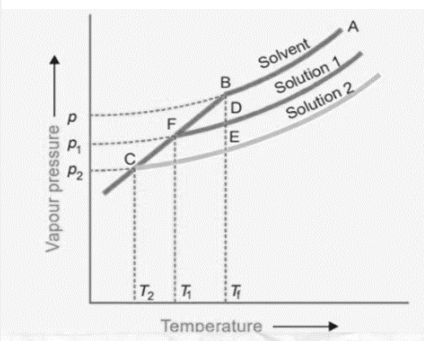
(a). An experiment was carried out in the laboratory, to study depression in freezing point. 1M aqueous solution of Al(NO3)3 and 1 M aqueous solution of glucose were taken. From the given figure identify solution 1 and solution 2. Give a plausible reason for your answer
Image
(b). The osmotic pressure of a solution of cane sugar was found to be 2.46 atm at 300 K. If the solution was diluted five times, calculate the osmotic pressure at the same temperature.
How can the osmotic pressure of the given cane sugar solution be decreased without changing its volume? Give a reason for your answer.
i. Write one chemical reaction for each
a. Carbylamine reaction
b. Acetylation reaction
ii. Write structure of N,N-ethylmethylethanamide
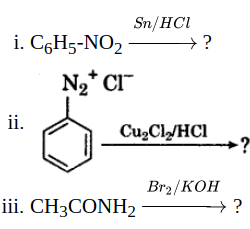
Write major product(s) in the following reaction .
Image
(a) Give reasons for the following:
(i) Sulphur in vapour state shows paramagnetic behaviour.
(ii) $N - N$ bond is weaker than $P - P$ bond.
(iii) Ozone is thermodynamically less stable than oxygen.
(b) Write the name of gas released when Cu is added to
(i) dilute $HNO _3$ and (ii) conc. $HNO _3$.
Write the IUPAC names of the following coordination compounds:
i. $\left[ Co \left( NH _3\right) 6\right] Cl _3$
ii. $\left[ Co \left( NH _3\right)_5 Cl \right] Cl _2$
iii. $K_3\left[ Fe ( CN )_6\right]$
iv. $K_3\left[ Fe \left( C _2 O _4\right)_3\right]$
v. $K_2\left[P_{d C l}^4\right]$
vi. $\left[ Pt \left( NH _3\right)_2 Cl \left( NH _2 CH _3\right)\right] Cl$
i. Write the structures of main products when benzene diazonium chloride reacts with the following reagents:
a. H3PO2 + Hp
b. CuCN/KCN
c. H₂O
ii. Arrange the following in the increasing order of their basic character in an aqueous solution: C2H5NH2, (C2H5)2NH, (C2H5)3N. Give justification.