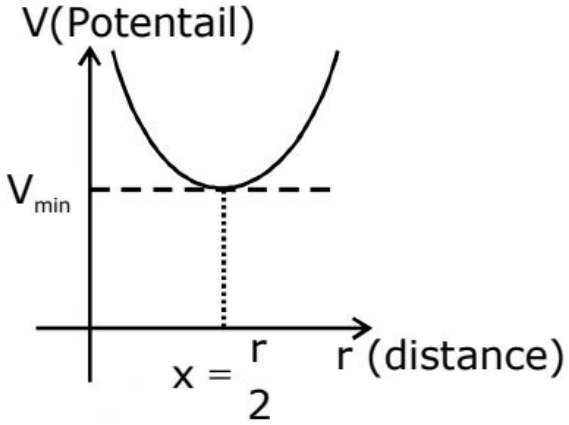
- Continuously increases.
- Continuously decreases.
- Increases then decreases.
- Decreases then increases.

Explanation:

$\text{V}=\frac{\text{KQ}}{\text{r}}$
V → Electric Potential

$\text{V}_\text{p}=\frac{\text{KQ}}{\text{x}}+\frac{\text{KQ}}{\text{r}-\text{x}}=\frac{\text{KQ}\text{r}}{\text{x}(\text{r}-\text{x})}$
$\frac{\text{dvp}}{\text{dx}}=\frac{-\text{kQr}(\text{r}-2\text{x})}{\big(\text{r}(\text{r}-\text{x})\big)^2}=0$

$\text{r}=2\text{x},\ \text{x}=\frac{\text{r}}{2}$
$\text{V}_\text{Pmin}=\frac{\text{KQ}}{\frac{\text{r}}{2}}+\frac{\text{KQ}}{\frac{\text{r}}{2}}=\frac{4\text{KQ}}{\text{r}}$ at $\Big(\text{x}=\frac{\text{r}}{2}\Big)$
Generate a complete, print-ready paper with questions like this in minutes — across 16+ boards, with answer keys.
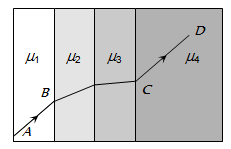
A ray of light passes through four transparent media with refractive indices
and
as shown in the figure. The surfaces of all media are parallel. If the emergent ray CD is parallel to the incident ray AB, we must have

|
(a) |
(b) |
(c) |
(d) |
If in the given figure, then resistance X will be
|
(a) 5Ω |
(b) 10 Ω |
(c) 15 Ω |
(d) 20 Ω |
Assertion : Television signals are received through sky-wave propagation.
Reason : The ionosphere reflects electromagnetic waves of frequencies greater than a certain critical frequency.
|
(a) If both assertion and reason are true and the reason is the correct explanation of the assertion. |
|
(b) If both assertion and reason are true but reason is not the correct explanation of the assertion. |
|
(c) If assertion is true but reason is false. |
|
(d) If the assertion and reason both are false. |