Two equal resistances when connected in series to a battery, consume electric power of $60\,W.$ If these resistances are now connected in parallel combination to the same battery, the electric power consumed will be .............. $W$
JEE MAIN 2019, Medium
Download our app for free and get started
Assuming constant voltage supply
$P=60=\frac{V^{2}}{R_{1}+R_{2}}$ .......$(1)$
$ \text { And } P^{\prime}=\frac{V^{2}}{R_{1}}+\frac{V^{2}}{R_{2}}=\frac{2 V^{2}}{R_{1}} =4 P=4 \times 60 $
$=240 \,\mathrm{W} $

Download our appand get started for free
Experience the future of education. Simply download our apps or reach out to us for more information. Let's shape the future of learning together!No signup needed.*
Similar Questions
- 1A potentiometer wire has length $4\,\, m$ and resistance $8\,\,\Omega $. The resistance that must be connected in series with the wire and an accumulator of e.m.f. $2\,\, V,$ so as to get a potential gradient $1\,\, m \,V$ per $cm$ on the wire is ............. $\Omega$View Solution
- 2Eight copper wire of length $l$ and diameter $d$ are joined in parallel to form a single composite conductor of resistance $R$. If a single copper wire of length $2\,l$ have the same resistance $(R)$ then its diameter will be $.....d$.View Solution
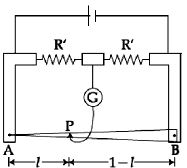
- 3In a meter bridge, the wire of length $1\, m$ has a nonuniform cross-section such that, the variation $\frac{{dR}}{{d\ell }}$ of its resistance $R$ with length $\ell $ is $\frac{{dR}}{{d\ell }} \propto \frac{1}{{\sqrt \ell }}$ Two equal resistances are connected as shown in the figure. The galvanometer has zero deflection when the jockey is at point $P$. What is the length $AP$ ? ................ $m$View Solution
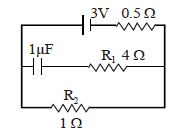
- 4A $1\,\mu F$ capacitor is connected in the circuit shown below. The emf of the cell is $3\ volts$ and internal resistance is $0.5\ ohms$ . The resistors $R_1$ and $R_2$ have values $4\ ohms$ and $1\ ohm$ respectively. The charge on the capacitor in steady state must be.......$\mu C$View Solution
- 5$n$ identical cells are joined in series with two cells $A$ and $B$ with reversed polarities. $emf$ of each cell is $E$ and internal resistance is $r$. Potential difference across cell $A$ and $B$ is : $(n > 4)$View Solution
- 6A beam contains $2 \times 10^8$ doubly charged positive ions per cubic centimeter, all of which are moving with a speed of $10^5 \,m/s$. The current density is ............. $A/m^2$View Solution
- 7View SolutionTwo resistors having equal resistances are joined in series and a current is passed through the combination. Neglect any variation in resistance as the temperature changes. In a given time interval
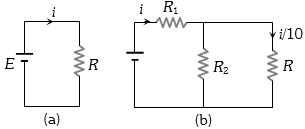
- 8Consider the circuits shown in the figure. Both the circuits are taking same current from battery but current through $R$ in the second circuit is $\frac{1}{{10}}$$^{th}$ of current through $R$ in the first circuit. If $R$ is $11$ $\Omega$, the value of $ R_1$ ................ $\Omega$View Solution
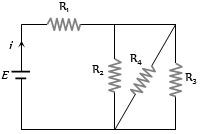
- 9In the circuit given $E = 6.0 \,V, R_1 = 100\, ohms, R_2 = R_3 = 50\, ohms, R_4 = 75\, ohms$. The equivalent resistance of the circuit, in $ohms$, isView Solution
- 10View SolutionThe resistance of a conductor increases with