Question
Two free parallel wires carrying currents in opposite direction
| (a) Attract each other |
| (b) Repel each other |
| (c) Neither attract nor repel |
| (d) Get rotated to be perpendicular to each other |
Two free parallel wires carrying currents in opposite direction
| (a) Attract each other |
| (b) Repel each other |
| (c) Neither attract nor repel |
| (d) Get rotated to be perpendicular to each other |
(b) Repel each other
Generate a complete, print-ready paper with questions like this in minutes — across 16+ boards, with answer keys.
In an experiment, a graph was plotted of the potential difference V between the terminals of a cell against the circuit current i by varying load rheostat. Internal conductance of the cell is given by
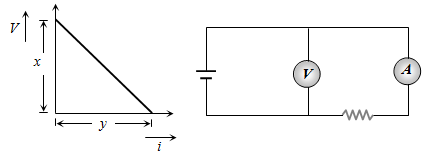
|
(a) xy |
(b) |
(c) |
(d) (x – y) |
In a concave mirror experiment, an object is placed at a distance  from the focus and the image is formed at a distance
  from the focus. The focal length of the mirror would be
|
(a) |
(b) |
(c) |
(d) |
In any Bohr orbit of the hydrogen atom, the ratio of kinetic energy to potential energy of the electron is
|
(a) 1/2 |
(b) 2 |
(c) -1/2 |
(d) -2 |
Two plates are at potentials –10 V and +30 V. If the separation between the plates be 2 cm. The electric field between them is
|
(a) 2000 V/m |
(b) 1000 V/m |
(c) 500 V/m |
(d) 3000 V/m |
The length of a wire of a potentiometer is 100 cm, and the emf of its standard cell is E volt. It is employed to measure the e.m.f of a battery whose internal resistance is 0.5 W. If the balance point is obtained at l = 30 cm from the positive end, the e.m.f. of the battery is (where i is the current in the potentiometer)
|
(a) |
(b) |
(c) |
(d) |
The ratio of electric fields on the axis and at equator of an electric dipole will be
|
(a) 1 : 1 |
(b) 2 : 1 |
(c) 4 : 1 |
(d) None of these |
Two electric bulbs (60W and 100W respectively) are connected in series. The current passing through them is
|
(a) More in 100W bulb |
(b) More in 60W bulb |
(c) Same in both |
(d) None of these |
Assertion : The refractive index of diamond is  and that of liquid is
  . If the light travels from diamond to the liquid, it will totally reflected when the angle of incidence is 30o.
Reason : μ =  where m is the refractive index of diamond with respect to liquid.
|
(a) If both assertion and reason are true and the reason is the correct explanation of the assertion. |
|
(b) If both assertion and reason are true but reason is not the correct explanation of the assertion. |
|
(c) If assertion is true but reason is false. |
|
(d) If assertion is false but reason is true. |


