MCQ
Two free parallel wires carrying currents in opposite direction,
  • A
    attract each other
  • repel each other.
  • C
    neither attract nor repel.
  • D
    get rotated to be perpendicular to each other.

Answer

Correct option: B.
repel each other.
B

Need a full question paper?

Generate a complete, print-ready paper with questions like this in minutes — across 16+ boards, with answer keys.
Start Generating Free

Similar questions

Consider two thin identical conducting wires covered with very thin insulating material. One of the wires is bent into a loop and produces magnetic field $B_1,$ at its centre when a current $I$ passes through it.The second wire is bent into a coil with  three identical loops adjacent to each other and produces magnetic field $B_2$ at the centre of the loops when current $I/3$ passes through it. The ratio $B_1 : B_2$ is
$3\,moles$ of an ideal gas at a temperature of $27^{\circ}\,C$ are mixed with $2\,moles$ of an ideal gas at a temperature $227^{\circ}\,C$, determine the equilibrium temperature (${}^o C$) of the mixture, assuming no loss of energy.
Two identical conducting spheres having unequal positive charges $q_1$ and $q_2$ separated by distance $r$. If they are made to touch each other and then separated again to the same distance, the electrostatic force between them in this case will be :-
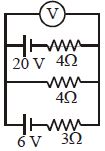
What will be reading of voltmeter ................. $V$
If we express the energy of a photon in $KeV$ and the wavelength in angstroms, then energy of a photon can be calculated from the relation
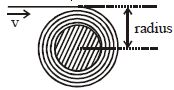
The given diagram shows a straight length of tape being wound on to a reel. The reel is rotating about a fixed axis with constant angular velocity and its radius is increasing at a steady rate. Which graph correctly shows the variation with time of the speed $v$ at which the tape moves towards the roll ?
Two identical positive charges are placed on the $y$-axis at $y=-a$ and $y=+a$. The variation of $V$ (electric potential) along $x$-axis is shown by graph
The slopes of isothermal and adiabatic curves are related as
Two moles of helium are mixed with $n$  with moles of hydrogen. If $\frac{{{C_P}}}{{{C_V}}}\, = \,\frac{3}{2}$  for the mixture, then the value of $n$  is
$64$ small drops of mercury, each of radius $ r$ and charge $q$ coalesce to form a big drop. The ratio of the surface density of charge of each small drop with that of the big drop is