MCQ
Two H atoms in the ground state collide inelastically. The maximum amount by which their combined kinetic energy is reduced is:
- A10.20eV.
- B20.40eV.
- C13.6eV.
- D27.2eV.
Solution:
Key concept: Total energy (E) is the sum of potential energy and kinetic energy, i.e. E = K + U
$\Rightarrow\ \text{E}=-\frac{\text{kZe}^2}{2\text{r}_\text{n}}\text{also r}_\text{n}=\frac{\text{n}^2\text{h}^2\in_0}{\pi\text{mze}^2}$
Hence $\text{E}=-\bigg(\frac{\text{me}^4}{8\in_0^2\text{h}^2}\bigg)\frac{\text{Z}^2}{\text{n}^2}=-\bigg(\frac{\text{me}^4}{8\in_0^2\text{ch}^3}\bigg)\text{ch}\frac{\text{Z}^2}{\text{n}^2}$
$=-\text{R ch}\frac{\text{Z}^2}{\text{n}^2}=-13.6\frac{\text{Z}^2}{\text{n}^2}\text{eV}$
The lowest state of the atom, called the ground state, is that of the lowest energy. The energy of this state (n = 1), E1 is -13.6eV
Energy level diagram of hydrogen/hydrogen like atom:
| Principal quantum number | Orbit | Excited state | Energy of H2 - atom |
| $\text{n}=\infty$ | Infinite | Infinite | 0eV |
| n = 4 | Fourth | Third | -0.85eV |
| n = 3 | Third | Second | -1.51eV |
| n = 2 | Second | First | -3.4eV |
| n = 1 | First | Ground | -13.6eV |
Let two H atoms initially at in the ground state.Now two stoms collide inclastically. The total energy associated with the tow H-atoms
= 2 × (13.6 eV) = 27.2eV
The maximum amount by which their combined kinetic energy is reduced when any one of them goes into first excited state (n = 2) after the inclastic collision.
The total energy associated with the two H-atoms after the collision
$=\Big(\frac{13.6}{2^2}\Big)+(13.6)=17.0\text{eV}$
Hence, maximum loss of their combined kinetic energy
= 27.2 - 17.0 = 10.2eV.
Generate a complete, print-ready paper with questions like this in minutes — across 16+ boards, with answer keys.
When the momentum of a proton is changed by an amount P0, the corresponding change in the de-Broglie wavelength is found to be 0.25%. Then, the original momentum of the proton was
|
(a) p0 |
(b) 100 p0 |
(c) 400 p0 |
(d) 4 p0 |
A convex lens of crown glass (n =1.525) will behave as a divergent lens if immersed in
|
(a) Water (n = 1.33) |
(b) In a medium of n = 1.525 |
|
(c) Carbon disulphide n = 1.66 |
(d) It cannot act as a divergent lens |
Two identical batteries, each of e.m.f. 2 volt and internal resistance 1.0 ohm are available to produce heat in an external resistance R = 0.5 ohm by passing a current through it. The maximum Joulean power that can be developed across R using these batteries is
|
(a) 1.28 watt |
(b) 2.0 watt |
(c) |
(d) 3.2 watt |
Fraunhofer lines are obtained in
|
(a) Solar spectrum |
(b) The spectrum obtained from neon lamp |
|
(c) Spectrum from a discharge tube |
(d) None of the above |
What is the effective capacitance between points X and Y
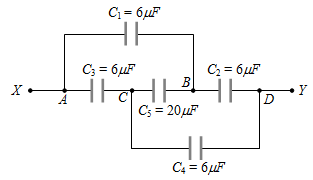
|
(a) 24 μF |
(b) 18 μF |
(c) 12 μF |
(d) 6 μF |
In a PN-junction
|
(a) P and N both are at same potential |
|
(b) High potential at N side and low potential at P side |
|
(c) High potential at P side and low potential at N side |
|
(d) Low potential at N side and zero potential at P side |
Which of the following will produce greater chromatic aberration?
