Question
Two harmonic waves of monochromatic light$\text{y}_{1} = \text{a} \cos\omega\text{t}\text{ and } \text{y}_{2} = \text{a} \cos(\omega\text{t} + \Phi)$
are superimposed on each other. Show that maximum intensity in interference pattern is four times the intensity due to each slit. Hence write the conditions for constructive and destructive interference in terms of the phase angle$\Phi$.
Answer

Resultant displacement $\text{y} = \text{y}_{1} + \text{y}_{2}$ $ = \text{a}[ \cos(\omega\text{t}) + \cos(\omega\text{t} + \phi)]$ $ = 2 \text{ a}\cos\big(\frac{\phi}{2}\big)\cos\big(\omega\text{t} +\frac{\phi}{2}\big)$ $\therefore$ amplitude of resultant wave $= 2 \text{ a}\cos(\frac{\phi}{2} )$$\therefore$ Intensity $ = 4 \text{I}_{o}\cos^{2}(\frac{\phi}{2}) , \text{where } \text{I}_{o} =\text{a}^{2}$ is the intensity of each harmonic wave
At the maxima, $\phi =\pm2\text{n}\pi\therefore\cos^{2}\frac{\phi}{2} = 1 $ At the maxima, $\text{I} = 4 \text{ I}_{o} = 4 \times\text{intensity due to one slit }$ $\text{I} = 4 \text{ I}_{o}\cos^{2}(\frac{\phi}{2})$ For constructive interference, I is maximum It is possible when $\cos^{2}(\frac{\phi}{2}) =1 ; \frac{\phi}{2} =\text{n}\pi; \phi = 2 \text{n}\pi$ For destructive interference, I is minimum, i.e, I=0 It is possible when $\cos^{2}(\frac{\phi}{2}) = 0 ; \frac{\phi}{2} = \frac{(2\text{n} - 1 )\pi}{2}; \phi = (2\text{n}\pm1 )\frac{\phi}{2}$.

Need a full question paper?

Generate a complete, print-ready paper with questions like this in minutes — across 16+ boards, with answer keys.

Start Generating Free

Similar questions

The thickness of a glass plate is measured to be 2.17mm, 2.17mm and 2.18mm at three different places. Find the average thickness of the plate from this data.
If the frequency of light falling on a metal is doubled, what will be the effect on photocurrent and the maximum kinetic energy of emitted photoelectrons?
If heavier bodies are attracted more strongly by the earth, why don't they fall faster than the lighter bodies?
A particle goes in a circle of radius 2.0cm. A concave mirror of focal length 20cm is placed with its principal axis passing through the centre of the circle and perpendicular to its plane. The distance between the pole of the mirror and the centre of the circle is 30cm. Calculate the radius of the circle formed by the image.
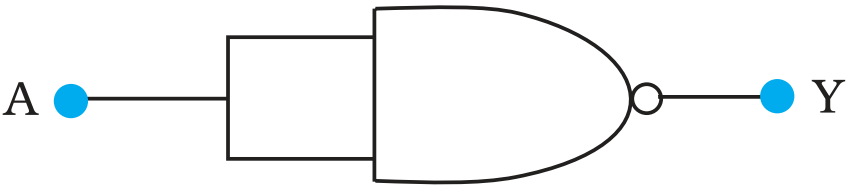
Write the truth table for a NAND gate connected as given in Fig. 14.45.

Hence identify the exact logic operation carried out by this circuit.
A neutron is absorbed by a $^{6}_{3}\text{Li}$ nucleus with the subsequent emission of an alpha particle.
  1. Calculate the energy released, in MeV, in this reaction.
  2. Write the corresponding nuclear reaction.
Given: mass $^{6}_{3}\text{Li} =6015126 $ u; mass (neutron) =1.0086654 u; mass (alpha particle) = 4.0026044 u and mass (triton) = 3.0100000 u. Take $1\ u = 931\ MeV/C^2.$
With the help of a circuit diagram, explain the working of a junction diode as a full wave rectifier. Draw its input and output waveforms. Which characteristic property makes the junction diode suitable for rectification?
A ball is given a speed v on a rough horizontal surface. The ball travels through a distance l on the surface and stops.
  1. What are the initial and final kinetic energies of the ball?
  2. What is the work done by the kinetic friction?
A circular ring of radius r made of a nonconducting material is placed with its axis parallel to a uniform electric field. The ring is rotated about a diameter through 180°. Does the flux of electric field change? If yes, does it decrease or increase?
Explain the construction of refracting telescope by figure and obtain the equation of magnification.