Two heater wires of equal length are first connected in series and then in parallel. The ratio of heat produced in the two cases is
AIIMS 2000, Medium


Download our appand get started for free
Experience the future of education. Simply download our apps or reach out to us for more information. Let's shape the future of learning together!No signup needed.*
Similar Questions
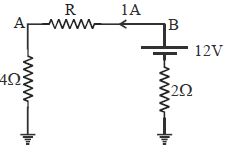
- 1View SolutionIn the given circuit
- 2View SolutionThrough a semiconductor, an electric current is due to drift of
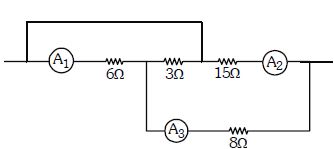
- 3A part of circuit is shown in figure. All the ammeters are ideal. If reading of ammeter $A_1$ is $1.0\ A$ , thenView Solution
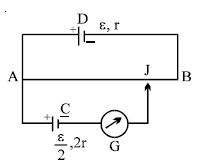
- 4In the figure, the potentiometer wire $AB$ of length $L$ and resistance $9r$ is joined to the cell $D$ of $\mathrm{emf}$ $\varepsilon$ and internal resistance $r$. The cell $C’s$ $\mathrm{emf}$ is $\varepsilon /2$ and its internal resistance is $2r$. The galvanometer $G$ will show no deflection when the length $AJ$ isView Solution
- 5View SolutionTwo identical heater filaments are connected first in parallel and then in series. At the same applied voltage, the ratio of heat produced in same time for parallel to series will be:
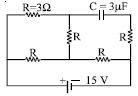
- 6In the circuit shown, the cell is ideal, with $emf$ $=$ $15$ $V$. Each resistance is of $3 $ $\Omega$ . The potential difference across the capacitor is.....$V$View Solution
- 7The voltage of clouds is $4 \times 10^6\,volt$ with respect to round. In a lighteing strike lasting $100\,m\,sec$, a charge of $4\,coulombs$ is delivered to the ground. The power of lightening strike isView Solution
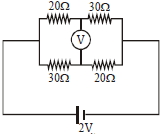
- 8The reading of an ideal voltmer in the circuit shown is.....$V$View Solution
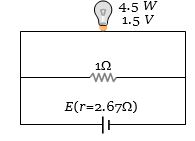
- 9A torch bulb rated as $4.5\, W$, $1.5\, V$ is connected as shown in the figure. The $e.m.f.$ of the cell needed to make the bulb glow at full intensity is ................ $V$View Solution
- 10A storage cell is charged by $5\, amp$ $D.C.$ for $18$ hours. Its strength after charging will be .............. $AH$View Solution