MCQ
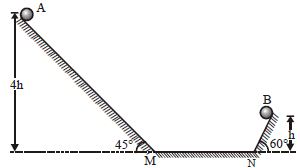
Two identical balls $A$ and $B$ are released from the positions shown in figure. They collide elastically on horizontal portion $MN$. The ratio of the height attained by $A$ and $B$ after collision will be: (neglect friction)
  • A
    $1 : 4$
  • B
    $2 : 1$
  • $4 : 13$
  • D
    $2 : 5$

Answer

Correct option: C.
$4 : 13$
c
After the collision the balls exchange their velocities, i.e.

$v_{A}=\sqrt{2 g h} \quad \text { and } \quad v_{B}=2 \sqrt{2 g h}$

Height attained by $A$ will be

$\mathrm{h}_{\mathrm{A}}=\frac{\mathrm{v}_{\mathrm{A}}^{2}}{2 \mathrm{g}}=\mathrm{h}$            $...(1)$

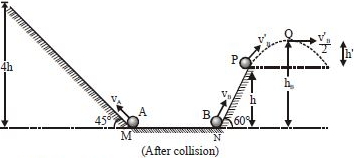
But path of $B$ will be first straight line from $N$ to $\mathrm{P}$ and then parabolic from point $\mathrm{P}$ as shown in fig.

Calculation of max height attained by $B.$ velocity of $\mathrm{B}$ at point $\mathrm{P}$

$\mathrm{v}_{\mathrm{B}}^{\prime 2}=\mathrm{v}_{\mathrm{B}}^{2}-2 \mathrm{gh}=6 \mathrm{gh}$             $...(2)$

After reaching at point $P$ it will move in parabolic height.

So here $h^{\prime}=\frac{v_{B}^{\prime 2}\left(\sin 60^{\circ}\right)^{2}}{2 g}=\frac{9 h}{4}$

$\Rightarrow$ max. height attained by $\mathrm{B}$

$h_{B}=h+h^{\prime}=h+\frac{9 h}{4}=\frac{13 h}{4}$         $...(3)$

from eq" $( 1)$ $\&$ $(3)$

$\frac{h_{A}}{h_{B}}=\frac{4}{13}$
Need a full question paper?

Generate a complete, print-ready paper with questions like this in minutes — across 16+ boards, with answer keys.

Start Generating Free

Similar questions

Moment of inertia of a cylinder of mass $M,$ length $L$ and radius $R$ about an axis passing through its centre and perpendicular to the axis of the cylinder is $I = M \left(\frac{ R ^{2}}{4}+\frac{ L ^{2}}{12}\right) .$ If such a cylinder is to be made for a given mass of material, the ratio $\frac LR$ for it to have minimum possible $I$ is
An ideal gas having molar specific heat capacity at constant volume is $\frac32\text{R}$ the molar specific heat capacities at constant pressure is:
Which graph represents the difference between total energy and potential energy of a particle executing $SHM$ Vs it's distance from mean position?
A block of mass $m$ moving at a speed $v$ compresses a spring through a distance $x$ before its speed becomes one fourth. Find the spring constant of the spring
A packet contains silver powder of mass $20.23 \,g \pm 0.01 \,g$. Some of the powder of mass $5.75 \,g \pm 0.01 \,g$ is taken out from it. The mass of the powder left back is ................
$70$ calories of heat are required to raise the temperature of $2$ moles of an ideal gas at constant pressure from $30°C$ to $35°C.$ The amount of heat required to raise the temperature of same gas through the same range $(30°C$ to $35°C)$ at constant volume ..... $cal$ $(R = 2 \,cal/mol/K)$
A person sitting in a chair in a satellite feels weightless because
Two rods of same length and cross section are joined along the length. Thermal conductivities of first and second rod are ${K_1}\,\,{\rm{and}}\,\,{K_2}$. The temperature of the free ends of the first and second rods are maintained at ${\theta _1}\,\,{\rm{and }}{\theta _2}$ respectively. The temperature of the common junction is
A block is kept on an inclined plane of inclination $\theta$ of length l. The velocity of particle at the bottom of inclined is (the coefficient of friction is $\mu$)
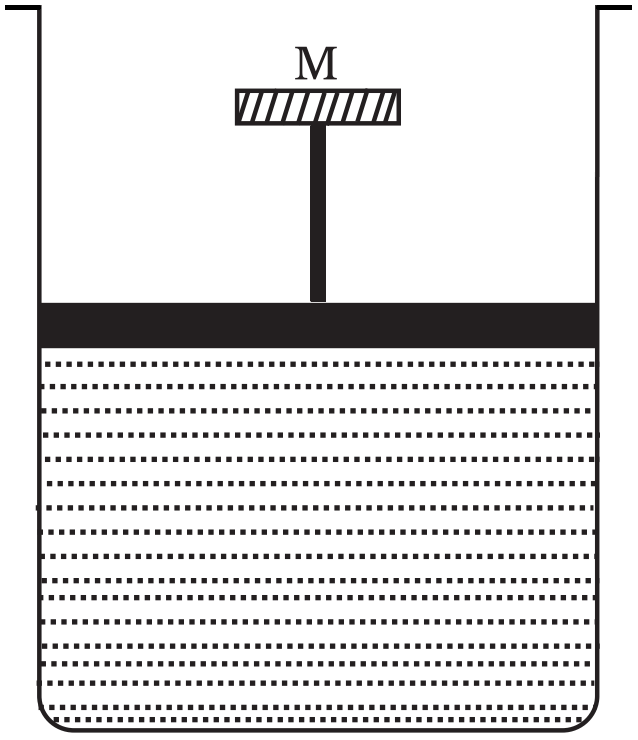
A cylinder containing an ideal gas is in vertical position and has a piston of mass M that is able to move up or down without friction ( figure). If the temperature is increased.

  1. Both P and V of the gas will change.
  2. Only P will increase according to Charles’ law.
  3. V will change but not P.
  4. P will change but not V.