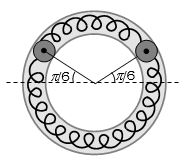
Two identical balls A and B each of mass 0.1 kg are attached to two identical massless springs. The spring mass system is constrained to move inside a rigid smooth pipe bent in the form of a circle as shown in the figure. The pipe is fixed in a horizontal plane. The centres of the balls can move in a circle of radius 0.06 m. Each spring has a natural length of 0.06$\pi$ m and force constant 0.1N/m. Initially both the balls are displaced by an angle $\theta = \pi /6$ radian with respect to the diameter $PQ$ of the circle and released from rest. The frequency of oscillation of the ball B is
Diffcult
Download our app for free and get started
(b)As here two masses are connected by two springs, this problem is equivalent to the oscillation of a reduced mass ${m_r}$ of a spring of effective spring constant.
$T = 2\pi \sqrt {\frac{{{m_r}}}{{{K_{eff.}}}}} $
Here ${m_r} = \frac{{{m_1}{m_2}}}{{{m_1} + {m_2}}} = \frac{m}{2}$ ==> ${K_{eff.}} = {K_1} + {K_2} = 2K$
$n = \frac{1}{{2\pi }}\sqrt {\frac{{{K_{eff.}}}}{{{m_r}}}} = \frac{1}{{2\pi }}\sqrt {\frac{{2K}}{m} \times 2} $$ = \frac{1}{\pi }\sqrt {\frac{K}{m}} = \frac{1}{\pi }\sqrt {\frac{{0.1}}{{0.1}}} = \frac{1}{\pi }Hz$
$T = 2\pi \sqrt {\frac{{{m_r}}}{{{K_{eff.}}}}} $
Here ${m_r} = \frac{{{m_1}{m_2}}}{{{m_1} + {m_2}}} = \frac{m}{2}$ ==> ${K_{eff.}} = {K_1} + {K_2} = 2K$
$n = \frac{1}{{2\pi }}\sqrt {\frac{{{K_{eff.}}}}{{{m_r}}}} = \frac{1}{{2\pi }}\sqrt {\frac{{2K}}{m} \times 2} $$ = \frac{1}{\pi }\sqrt {\frac{K}{m}} = \frac{1}{\pi }\sqrt {\frac{{0.1}}{{0.1}}} = \frac{1}{\pi }Hz$

Download our appand get started for free
Experience the future of education. Simply download our apps or reach out to us for more information. Let's shape the future of learning together!No signup needed.*
Similar Questions
- 1Two particles oscillating in $SHM$ along two very close parallel path such that they have same mean position. The equation of $SHM$ of two particles are $x_1 = A\, sin\,\omega t$ and $x_2 = A\,sin(\omega t + \phi )$ respectively. If maximum distance between them is $\frac{6A}{5}$ then $\phi $ equal to ..... $^o$View Solution
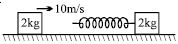
- 2A $2\, Kg$ block moving with $10\, m/s$ strikes a spring of constant $\pi ^2 N/m$ attached to $2\, Kg$ block at rest kept on a smooth floor, the velocity of the rear $2\, kg$ block after it separates from the spring will be ..... $m/s$View Solution
- 3Two pendulum have time periods $T$ and $5T/4$. They start $SHM$ at the same time from the mean position. After how many oscillations of the smaller pendulum they will be again in the same phaseView Solution
- 4A particle is executing simple harmonic motion $(SHM)$ of amplitude $A,$ along the $x-$ axis, about $x = 0.$ When its potential energy $(PE)$ equals kinetic energy $(KE),$ the position of the particle will beView Solution
- 5For a simple pendulum, a graph is plotted between its kinetic energy $(KE)$ and potential energy $(PE)$ against its displacement $d.$ Which one of the following represents these correctly ? (graphs are schematic and not drawn to scale)View Solution
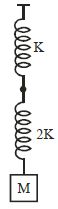
- 6Two springs of force constant $K$ and $2K$ are connected to a mass as shown below. The frequency of oscillation of the mass isView Solution
- 7View SolutionWhich one of the following is a simple harmonic motion
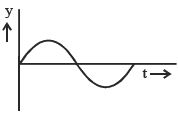
- 8The displacement versus time graph of $SHM$ is Which of the following is its acceleration versus time graph ?View Solution
- 9The amplitude of the vibrating particle due to superposition of two $SHMs,$View Solution
$y_1 = \sin \left( {\omega t + \frac{\pi }{3}} \right)$ and $y_2 = \sin \omega t$ is :
- 10Force constant of a spring is $K$ . If half part is detached then force constant of the remaining spring will beView Solution