Question
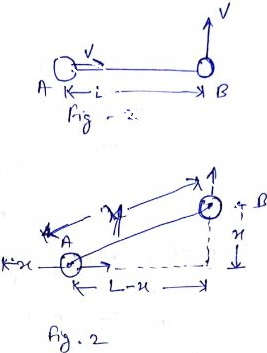
Two identical balls are interconnected with a massless and inextensible thread. The system is in gravity free space with the thread just taut. Each ball is imparted a velocity $v$, one towards the other ball and the other perpendicular to the first, at $t = 0$. Then,
Answer

As shown in figure $A$ and $B$ are two identical mass. Suppose $A$ move $x$ and $B$ move $x=$ because velocity is same. Length taught when $y>L$ $L=\sqrt{x^{2}+(L-x)^{2}}$

$L^{2}=x^{2}+L^{2}+x^{2}-2 l x$

$2 x^{2}-2 L x=0$

$2 x(x-L)=0$

$x=L$

time taken to travel $x=t=\frac{x}{V}=\left(\frac{L}{V}\right)$ thread will taught at $x=L$ and time $t=\frac{1}{2}$ and after that thread always taught because $y=\sqrt{x^{2}-\left(L-x^{2}\right)}$

$y>L d \quad f x>L$

Need a full question paper?

Generate a complete, print-ready paper with questions like this in minutes — across 16+ boards, with answer keys.

Start Generating Free

Similar questions

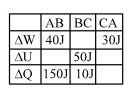
A student records $\Delta Q, \Delta U \& \Delta W$ for a thermodynamic cycle $A$ $\rightarrow$ $B \rightarrow C \rightarrow A$. Certain entries are missing. Find correct entry in following options.
By what percentage will the illumination of the lamp decrease if the current drops by $20 \%$ ?
One quarter sector is cut from a uniform circular disc of radius $R$. This sector has mass $M$. It is made to rotate about a line perpendicular to its plane and passing through the centre of the original disc. Its moment of inertia about the axis of rotation is
An $LC$ circuit contains a  $20\,\,mH$  inductor and a $50\,\,\mu F$ capacitor with an initial charge of  $10 \,\,mC.$ The resistance of the circuit is negligible. Let the instant the circuit is closed be $t = 0.$  At what time is the energy stored completely magnetic $t=$ .......... $m/s$
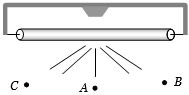
Figure shows a glowing mercury tube. The illuminances at point $A, B$ and $C$ are related as
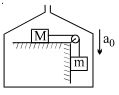
In figure, two blocks $M$ and $m$ are tied together with an inextensible and light string. The mass $M$ is placed on a rough horizontal surface with coefficient of friction $\mu$ and the mass $m$ is hanging vertically against a smooth vertical wall. The pulley is frictionless. Imagine a situation in which the given arrangement is placed inside an elevator that can move only in the vertical direction and compare the situation with the case when it is placed on the ground. When the elevator accelerates downward with $a_0( < g)$, then
Standing waves can be produced
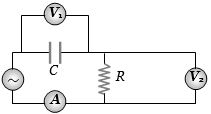
The diagram shows a capacitor $C$ and a resistor $R$ connected in series to an $ac$ source. ${V_1}$ and ${V_2}$ are voltmeters and $A$ is an ammeterConsider               now the following statements

             $I$.Readings in $A$ and $V_2$ are always in phase

             $II$.Reading in $V_1$ is ahead in phase with reading in $V_2$

             $III$.Readings in $A$ and $V_1$ are always in phase which of these statements are/is correct

The wave described by $y=0.25 \,sin\left[ {10\pi x - 2\pi t} \right]$, where $x$ and $y$ are in meters and $t$ in seconds, is a wave travelling along the 
A mass is hanging on a spring balance which is kept in a lift. The lift ascends. The spring balance will show in its readings