MCQ
Two identical balls are interconnected with a massless and inextensible thread. The system is in gravity free space with the thread just taut. Each ball is imparted a velocity $v$, one towards the other ball and the other perpendicular to the first, at $t = 0$. Then,
  • A
    the thread will become taut at $t = (L/v)$
  • B
    the thread will become taut at some time $t < (L/v).$
  • C
    the thread will always remain taut for $t > (L/v).$
  • Both $(A)$ and $(C)$

Answer

Correct option: D.
Both $(A)$ and $(C)$
d
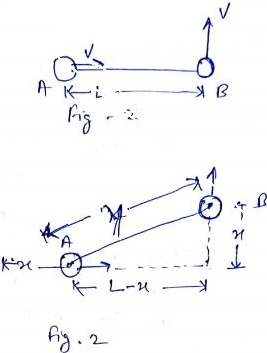
As shown in figure $A$ and $B$ are two identical mass. Suppose $A$ move $x$ and $B$ move $x=$ because velocity is same. Length taught when $y>L$ $L=\sqrt{x^{2}+(L-x)^{2}}$

$L^{2}=x^{2}+L^{2}+x^{2}-2 l x$

$2 x^{2}-2 L x=0$

$2 x(x-L)=0$

$x=L$

time taken to travel $x=t=\frac{x}{V}=\left(\frac{L}{V}\right)$ thread will taught at $x=L$ and time $t=\frac{1}{2}$ and after that thread always taught because $y=\sqrt{x^{2}-\left(L-x^{2}\right)}$

$y>L d \quad f x>L$

Need a full question paper?

Generate a complete, print-ready paper with questions like this in minutes — across 16+ boards, with answer keys.

Start Generating Free

Similar questions

Two lithium nuclei in a lithium vapour at room temperature do not combine to form a carbon nucleus because:
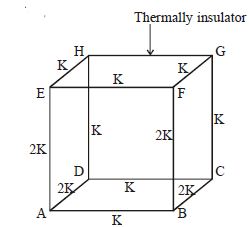
Find effective thermal resistance between $A$ & $B$ of cube made up of $12$ rods of same dimensions and shown given thermal conductivity. [ $l =$ length of rod, $a =$ cross section area of rod]
If momentum $[ P ]$, area $[ A ]$ and time $[ T ]$ are taken as fundamental quantities, then the dimensional formula for coefficient of viscosity is :
A particle is moving with velocity $\vec v = K(y\hat i + x\hat j)$ where $K$ is a constant. The general equation for its path is
A proton and an electron are placed in a uniform electric field.
​​​​​​
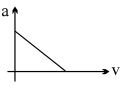
Acceleration versus velocity graph of a particle moving in a straight line starting from rest is as shown in figure. The corresponding velocity-time graph would be
The scale on a steel metre stick is calibrated at $20^o\,C$.The error in the reading of $50\,cm$ at $30^o\,C$ is: (take linear expansion coefficient of steel $= 1.0 \times 10^{-5} /  ^oC)$
A whistle emitting a loud sound of frequency $540 \,Hz$ is whirled in a horizontal circle of radius $2 \,m$ and at a constant angular speed of $15 \,rad / s$. The speed of sound is $330 \,m / s$. The ratio of the highest to the lowest frequency heard by a listener standing at rest at a large distance from the centre of the circle is
Two particle executing $S.H.M.$ of same amplitude of $20 \,cm$ with same period along the same line about same equilibrium position. The maximum distance between the two is $20 \,cm$. Their phase difference in radian is equal to
Two stones of different masses are dropped simultaneously from the top of a building