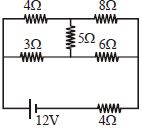
- A$\frac{1}{4} CV ^2$
- B$2 CV ^2$
- C$\frac{1}{2} CV ^2$
- D$\frac{3}{4} CV ^2$
Generate a complete, print-ready paper with questions like this in minutes — across 16+ boards, with answer keys.
| Column $I$ | Column $II$ |
|
$(A)$ $\mathrm{GM}_e \mathrm{M}_5$ $\mathrm{G} \rightarrow$ universal gravitational constant, $\mathrm{M}_{\mathrm{e}} \rightarrow$ mass of the earth, $\mathrm{M}_5 \rightarrow$ mass of the Sun |
$(p)$ (volt) (coulomb) (metre) |
|
$(B)$ $\frac{3 \mathrm{RT}}{\mathrm{M}} ; \mathrm{R} \rightarrow$ universal gas constant, $\mathrm{T} \rightarrow$ absolute temperature, $\mathrm{M} \rightarrow$ molar mass |
$(q)$ (kilogram) $(\text { metre) })^3$ (second) $)^{-2}$ |
| $(C)$ $\frac{F^2}{q^2 B^2}$ ;$\quad F \rightarrow$ force, $q \rightarrow$ charge, $B \rightarrow$ magnetic field | $(r)$ $(\text { meter })^2$ (second) $)^{-2}$ |
|
$(D)$ $\frac{\mathrm{GM}_e}{\mathrm{R}_{\mathrm{e}}}, G \rightarrow$ universal gravitational constant, $\mathrm{M}_{\mathrm{e}} \rightarrow$ mass of the earth, $\mathrm{R}_{\mathrm{e}} \rightarrow$ radius of the earth |
$(s)$ (farad) $(\text { volt) })^2(\mathrm{~kg})^{-1}$ |

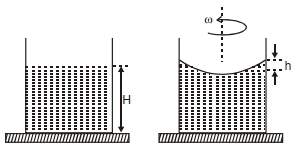
$(A)$ $R=\frac{h^2+r^2}{2 h}$
$(B)$ $R=\frac{3 r^2}{2 h}$
$(C)$ Apparent depth of the bottom of the beaker is close to $\frac{3 H }{2}\left(1+\frac{\omega^2 H }{2 g }\right)^{-1}$
$(D)$ Apparent depth of the bottom of the beaker is close to $\frac{3 H }{4}\left(1+\frac{\omega^2 H}{4 g }\right)^{-1}$