MCQ
Two identical capacitors have same capacitance $C$. One of them is charged to the potential $\mathrm{V}$ and other to the potential $2 \mathrm{~V}$. The negative ends of both are connected together. When the positive ends are also joined together, the decrease in energy of the combined system is :
  • $\frac{1}{4} \mathrm{CV}^2$
  • B
    $2 \mathrm{CV}^2$
  • C
    $\frac{1}{2} \mathrm{CV}^2$
  • D
    $\frac{3}{4} \mathrm{CV}^2$

Answer

Correct option: A.
$\frac{1}{4} \mathrm{CV}^2$
a
$\mathrm{V}_{\mathrm{C}}-\frac{\mathrm{q}_{\text {net }}}{\mathrm{C}_{\text {net }}}=\frac{\mathrm{CV}+2 \mathrm{CV}}{2 \mathrm{C}}$

$\mathrm{V}_{\mathrm{C}}=\frac{3 \mathrm{~V}}{2}$

Loss of energy

$=\frac{1}{2} \mathrm{CV}^2+\frac{1}{2} \mathrm{C}(2 \mathrm{~V})^2-\frac{1}{2} 2 \mathrm{C}\left(\frac{3 \mathrm{~V}}{2}\right)^2$

$=\left(\frac{\mathrm{CV}^2}{4}\right)$

Need a full question paper?

Generate a complete, print-ready paper with questions like this in minutes — across 16+ boards, with answer keys.

Start Generating Free

Similar questions

A solid uniform sphere having a mass $M$, radius $R$ and moment of inertia of $\frac{2}{5} M R^2$ rolls down a plane inclined at an angle $\theta$ to the horizontal starting from rest. The coefficient of static friction between the sphere and the plane is $\mu_s$. Then,
In hydrogen atom, electron makes transition from $n=4$ to $n=1$ level. Recoil momentum of the $H$ atom will be
Which one of the following compounds is prepared in the laboratory from benzene by a substitution reaction
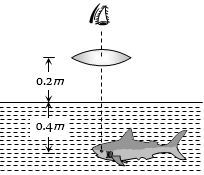
A small fish $0.4\, m$ below the surface of a lake, is viewed through a simple converging lens of focal length $3\, m$. The lens is kept at $0.2\, m$ above the water surface such that fish lies on the optical axis of the lens. The image of the fish seen by observer will be at $\left( {{\mu _{water}} = \frac{4}{3}} \right)$
The de-Broglie wavelength of a particle moving with a velocity $2.25 × 10^8$ m/s is equal to the wavelength of photon. The ratio of kinetic energy of the particle to the energy of the photon is (velocity of light is $3 × 10^8$ m/s)
Two spherical stars $A$ and $B$ have densities $\rho_A$ and $\rho_B$, respectively. $A$ and $B$ have the same radius, and their masses $M_A$ and $M_B$ are related by $M_B=2 M_A$. Due to an interaction process, star $A$ loses some of its mass, so that its radius is halved, while its spherical shape is retained, and its density remains $\rho_A$. The entire mass lost by $A$ is deposited as a thick spherical shell on $B$ with the density of the shell being $\rho_4$. If $v_A$ and $v_B$ are the escape velocities from $A$ and $B$ after the interaction process, the ratio $\frac{v_B}{v_A}=\sqrt{\frac{10 n}{15^{1 / 3}}}$. The value of $n$ is. . . . .
A proton moving with a constant velocity, passes through a region of space without change in its velocity. If $E$ $\& B$ represent the electric and magnetic fields respectively, this region may have
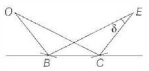
The image of an object $O$ due to reflection from the surface of a lake is elongated due to the ripples on the water surface caused by a light breeze. This is because the ripples act as tilted mirrors as shown below. Consider the case, where $O$ and the observer $E$ are at the same height above the surface of the lake. If the maximum angle that the ripples make with the horizontal is $\alpha$, then the angular extent $\delta$ of the image will be
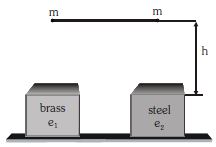
A dumbbell consisting of two masses $m$ each, connected by a light rigid rod of length $l$, falls on two pads of equal height, one steel and the other brass through a height $h$. The coefficient of restitution are $e_1$ and $e_2$ ($e_1 < e_2$). To what maximum height will the centre of mass of the dumbbell rise after bouncing of the pads?
A body of density ${d_1}$ is counterpoised by $Mg$ of weights of density ${d_2}$ in air of density $d$. Then the true mass of the body is