MCQ
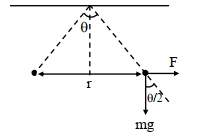
Two identical charged spheres are suspended by strings of equal lengths. The strings make an angle $\theta$ with each other. When suspended in water the angle remains the same. If density of the material of the sphere is $1.5 \mathrm{~g} / \mathrm{cc}$, the dielectric constant of water will be

(Take density of water $=1 \mathrm{~g} / \mathrm{cc}$ )

  • A
    $4$
  • B
    $8$
  • C
    $7$
  • $3$

Answer

Correct option: D.
$3$
d
In air $\tan \frac{\theta}{2}=\frac{F}{m g}=\frac{q^2}{4 \pi \varepsilon_0 \mathrm{r}^2 m g}$

In water $\tan \frac{\theta}{2}=\frac{\mathrm{F}^{\prime}}{\mathrm{mg}^{\prime}}=\frac{\mathrm{q}^2}{4 \pi \varepsilon_0 \varepsilon_{\mathrm{r}} \mathrm{r}^2 \mathrm{mg}_{\text {eff }}}$

Equate both equations

$\varepsilon_0 g=\varepsilon_0 \varepsilon_{\mathrm{r}} \mathrm{g}\left[1-\frac{1}{1.5}\right]$

$\varepsilon_{\mathrm{T}}=3$

Need a full question paper?

Generate a complete, print-ready paper with questions like this in minutes — across 16+ boards, with answer keys.

Start Generating Free

Similar questions

A hemispherical bowl of radius $R$ is rotated about its axis of symmetry which is kept vertical with angular velocity $\omega $ . A small block is kept in the bowl. It remains stationary relative to the bowl surface at a position where the radius makes an angle $\theta $ with the vertical. The friction is absent. The value of $\theta $ is
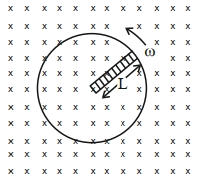
A metallic rod of length ' $L$ ' is rotated with an angular speed of ' $\omega$ ' normal to a uniform magnetic field ' $B$ ' about an axis passing through one end of rod as shown in figure. The induced emf will be :
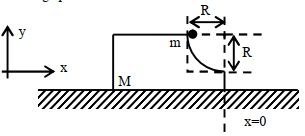
A block of mass $M$ has a circular cut with a frictionless surface as shown. The block rests on the horizontal frictionless surface of a fixed table. Initially the right edge of the block is at $x=0$, in a co-ordinate system fixed to the table. A point mass $m$ is released from rest at the topmost point of the path as shown and it slides down. When the mass loses contact with the block, its position is $\mathrm{x}$ and the velocity is $\mathrm{v}$. At that instant, which of the following options is/are correct?

(image)

$[A]$ The $x$ component of displacement of the center of mass of the block $M$ is : $-\frac{m R}{M+m}$.

[$B$] The position of the point mass is : $x=-\sqrt{2} \frac{\mathrm{mR}}{\mathrm{M}+\mathrm{m}}$.

[$C$] The velocity of the point mass $m$ is : $v=\sqrt{\frac{2 g R}{1+\frac{m}{M}}}$.

[$D$] The velocity of the block $M$ is: $V=-\frac{m}{M} \sqrt{2 g R}$.

Which one of the following characteristics is not associated with a ferromagnetic material
Two resistances ${R_1}$ and ${R_2}$ when connected in series and parallel with $120\, V$ line, power consumed will be $25\, W$ and $100\, W$ respectively. Then the ratio of power consumed by ${R_1}$ to that consumed by ${R_2}$ will be
A solution containing active cobalt ${}_{27}^{60}Co$ having activity of $0.8\,\mu Ci$ and decay constant $\lambda $ is injected in an animal's body. If $1 \,cm^3$ of blood is drawn from the animal's body after $10\, hrs$ of injection, the activity found was $300\, decays$ per minute. What is the volume of blood that is flowing in the body?..........$litres$ ( $ICi = 3.7 \times 10^{10}$ decay per second and at $t = 10\, hrs$ ${e^{ - \lambda t}} = 0.84$ )
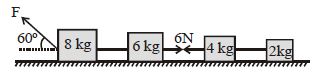
Figure shows four blocks that are being pulled along a smooth horizontal surface. The masses of the blocks and tension in one string are given. The pulling force $F$ is  ............ $ N$
An electric field, $\overrightarrow{\mathrm{E}}=\frac{2 \hat{\mathrm{i}}+6 \hat{\mathrm{j}}+8 \hat{\mathrm{k}}}{\sqrt{6}}$ passes through the surface of $4 \mathrm{~m}^2$ area having unit vector $\hat{\mathrm{n}}=\left(\frac{2 \hat{\mathrm{i}}+\hat{\mathrm{j}}+\hat{\mathrm{k}}}{\sqrt{6}}\right)$. The electric flux for that surface is $\mathrm{Vm}$
In a tangent galvanometer a current of $0.1 \,A $ produces a deflection of $30^o$. The current required to produce a deflection of $60^o$ is......$A$
Charges are placed on the vertices of a square as shown. Let $E$ be the electric field and $V$ the potential at the centre. If the charges on $A$ and $B$ are interchanged with those on $D$ and $C$ respectively, then