MCQ
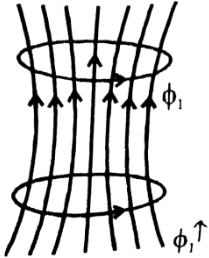
Two identical coaxial circular loops carry a current $i$ each circulating in the same direction. If the loops approach each other
  • the current in each will decrease
  • B
    the current in each will increase
  • C
    the current in each will remain the same
  • D
    the current in one will increase and in other will decrease
Answer

Correct option: A.
the current in each will decrease
a
Source flux $\phi_{1}$ increases so induce flux will oppose the source flux that's why it will produce. Current in opposite direction to main current. So current in each will decrease

Need a full question paper?

Generate a complete, print-ready paper with questions like this in minutes — across 16+ boards, with answer keys.

Start Generating Free

Similar questions

If the earth stops rotating, the value of $‘g’$ at the equator will
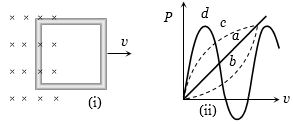
Figure $(i)$ shows a conducting loop being pulled out of a magnetic field with a speed $v$. Which of the four plots shown in figure $(ii)$ may represent the power delivered by the pulling agent as a function of the speed $v$
The electric field in a region is radially outward with magnitude $E = A{\gamma _0}$. The charge contained in a sphere of radius ${\gamma _0}$ centered at the origin is
A monatomic ideal gas undergoes a process in which the ratio of $\mathrm{P}$ to $\mathrm{V}$ at any instant is constant and equals to $1$. What is the molar heat capacity of the gas?
$Assertion :$ The root mean square and most probable speeds of the molecules in a gas are the same.
$Reason :$ The Maxwell distribution for the speed of molecules in a gas in symmetrical.
A body cools in $7$ minutes from ${60^o}C$ to ${40^o}C$ What time (in minutes) does it take to cool from ${40^o}C$ to ${28^o}C$ if the surrounding temperature is ${10^o}C$? Assume Newton’s Law of cooling holds
Electric potential at a point $P$ due to a point charge of $5 \times 10^{-9}\; C$ is $50 \;V$. The distance of $P$ from the point charge is ......... $cm$

(Assume, $\frac{1}{4 \pi \varepsilon_0}=9 \times 10^{+9}\; Nm ^2 C ^{-2}$)

$1 \,kg$ of ice at $-20^{\circ} C$ is mixed with $2 \,kg$ of water at $90^{\circ} C$. Assuming that there is no loss of energy to the environment, the final temperature of the mixture is ............ $^{\circ} C$ (Assume, latent heat of ice $=334.4 \,kJ / kg$, specific heat of water and ice are $4.18 \,kJ kg ^{-1} K ^{-1}$ and $2.09 \,kJ kg ^{-1}- K ^{-1}$, respectively.)
When a longitudinal wave propagates through a medium, the particles of the medium execute simple harmonic oscillations about their mean positions. These oscillations of a particle are characterised by an invariant
The power radiated by a black body is $P$ and it radiates maximum energy at wavelength,$\lambda_0.$  If the temperature of the black body is now changed so that it radiates maximum energy at wavelength $\frac{3}{4}\lambda_0$, the power radiated by it becomes $nP$. The value of $n$ is