MCQ
Two identical conducting rods are first connected independently to two vessels, one containing water at $100 C$ and the other containing ice at $0 . C$. In the second case, the rods are joined end to end and connected to the same vessels. Let $q$ and $q, \mathrm{~g} / \mathrm{s}$ be the rate of melting of ice in two cases respectively. The ratio of $q_1 / q_2$ is
  • A
    $\frac{1}{2}$
  • B
    $\frac{2}{1}$
  • $\frac{4}{1}$
  • D
    $\frac{1}{4}$

Answer

Correct option: C.
$\frac{4}{1}$

Need a full question paper?

Generate a complete, print-ready paper with questions like this in minutes — across 16+ boards, with answer keys.

Start Generating Free

Similar questions

A ray of light travelling inside a rectangular glass block of refractive index $\sqrt{2}$ is incident on the glass-air surface at an angle of incidence of $45^{\circ}$. The refractive index of air is $1$ . Under these conditions the ray
A force vector applied on a mass is represented as $\vec{F}=6 \hat{i}-8 \hat{j}+10 \hat{k}$ and accelerates with $1 \ m / s ^2$. What will be the mass of the body
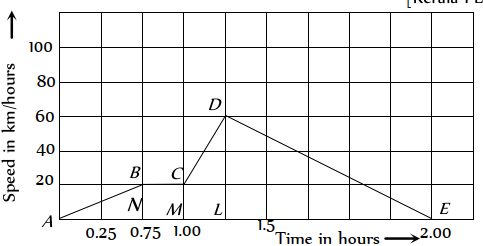
A train moves from one station to another in 2 hours time. Its speed-time graph during this motion is shown in the figure. The maximum acceleration during the journey is
Image
Intensity level $200 \mathrm{~cm}$ from a source of sound is $80 \mathrm{~dB}$. If there is no loss of acoustic power in air and intensity of threshold hearing is $10^{-12} \mathrm{Wm}^{-2}$ then, what is the intensity level at a distance of 400 cm from source
A fist looking from within water sees the outside world through a circular horizon. If the fish $\sqrt{7} \mathrm{~cm}$ below the surface of water, what will be the radius of the circular horizon
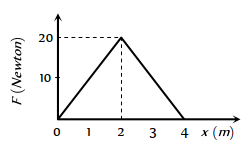
The graph between the resistive force $F$ acting on a body and the distance covered by the body is shown in the figure. The mass of the body is $25 \mathrm{~kg}$ and initial velocity is $2 \mathrm{~m} / \mathrm{s}$. When the distance covered by the body is $4 m$, its kinetic energy would be
Image
A stationary particle explodes into two particles of a masses $m$ and $m$ which move in opposite directions with velocities $v_1$ and $v_2$. The ratio of their kinetic energies $E_1 / E_2$ is
The acceleration due to gravity is $g$ at a point distant $r$ from the centre of earth of radius $R$. If $r
The resistance of $1 A$ ammeter is $0.018 \Omega$. To convert it into $10 A$ ammeter, the shunt resistance required will be
A body moves with constant angular velocity on a circle. Magnitude of angular acceleration