MCQ
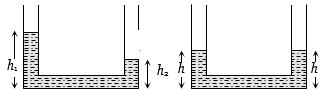
Two identical cylindrical vessels with their bases at same level each contains a liquid of density $\rho$. The height of the liquid in one vessel is ${h_1}$ and that in the other vessel is ${h_2}$. The area of either base is $A$. The work done by gravity in equalizing the levels when the two vessels are connected, is
  • A
    $({h_1} - {h_2})g\rho $
  • B
    $({h_1} - {h_2})gA\rho $
  • C
    $\frac{1}{2}{({h_1} - {h_2})^2}gA\rho $
  • $\frac{1}{4}{({h_1} - {h_2})^2}gA\rho $

Answer

Correct option: D.
$\frac{1}{4}{({h_1} - {h_2})^2}gA\rho $
d
(d)If $h$ is the common height when they are connected, by conservation of mass

$\rho A_{1} h_{1}+\rho A_{2} h_{2}=\rho h\left(A_{1}+A_{2}\right)$

$h=\left(h_{1}+h_{2}\right) / 2\;\;\;\left[\right.$ as $A_{1}=A_{2}=A$ given $]$

As $\left(h_{1} / 2\right)$ and $\left(h_{2} / 2\right)$ are heights of initial centre of gravity of liquid in two vessels., the initial potential energy of the system $U_{i}=\left(h_{1} A \rho\right) g \frac{h_{1}}{2}+\left(h_{2} A \rho\right) \frac{h_{2}}{2}=\rho g A \frac{\left(h_{1}^{2}+h_{2}^{2}\right)}{2} \ldots( i )$

When vessels are connected the height of centre of gravity of liquid in each vessel will be $h / 2$, i.e. $\left(\frac{\left(h_{1}+h_{2}\right)}{4}\right.$ [as $\left.h=\left(h_{1}+h_{2}\right) / 2\right]$

Final potential energy of the system

$U_{F}=\left[\frac{\left(h_{1}+h_{2}\right)}{2} A \rho\right] g\left(\frac{h_{1}+h_{2}}{4}\right)$

$=A \rho g\left[\frac{\left(h_{1}+h_{2}\right)^{2}}{4}\right] \ldots$.(ii)

Work done by gravity $W=U_{i}-U_{f}=\frac{1}{4} \rho g A\left[2\left(h_{1}^{2}+h_{2}^{2}\right)-\left(h_{1}+h_{2}\right)^{2}\right]$

$=\frac{1}{4} \rho g A\left(h_{1}-h_{2}\right)^{2}$
Need a full question paper?

Generate a complete, print-ready paper with questions like this in minutes — across 16+ boards, with answer keys.

Start Generating Free

Similar questions

A person blows into open-end of a long pipe. As a result, a high-pressure pulse of air travels down the pipe. When this pulse reaches the other end of the pipe.

$(A)$ a high-pressure pulse starts traveling up the pipe, if the other end of the pipe is open.

$(B)$ a low-pressure pulse starts traveling up the pipe, if the other end of the pipe is open.

$(C)$ a low-pressure pulse starts traveling up the pipe, if the other end of the pipe is closed.

$(D)$ a high-pressure pulse starts traveling up the pipe, if the other end of the pipe is closed.

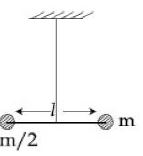
Two masses $m$ and $\frac{m}{2}$ are connected at the two ends of a massless rigid rod of length $l$. The rod is suspended by a thin wire of torsional constant $k$ at the centre of mass of the rodmass system (see figure). Because of torsional constant $k$, the restoring torque is $\tau  = k\,\theta $ for angular displacement $\theta $. If the rod is rotated by $\theta _0$ and released, the tension in it when it passes through its mean position will be
The angle between vector $\vec{Q}$ and the resultant of $(2 \overrightarrow{\mathrm{Q}}+2 \overrightarrow{\mathrm{P}})$ and $(2 \overrightarrow{\mathrm{Q}}-2 \overrightarrow{\mathrm{P}})$ is:
If the ratio of radii of two liquid drops is 1 : 2 then the ratio of their pressure excess will be
The potential energy in joules of a particle of mass $1\, kg$ moving in a plane is given by $U = 3x + 4y$, the position coordinates of the point being $x$ and $y$, measured in metres. If the particle is initially at rest at $(6,4)$, then
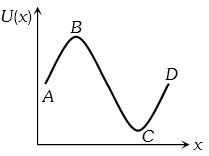
The potential energy of a particle varies with distance $x$ as shown in the graph.The force acting on the particle is zero at
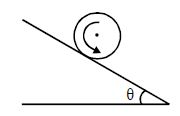
A disc is given angular velocity ${\omega _0}$ as shown in figure and kept on an inclined plane of inclination $\theta $ having coefficient of friction $\mu$ = $tan \theta $ . The initial acceleration of centre of mass is $a$ and angular acceleration $\alpha $ , then
A big ball of mass $M$, moving with velocity $u$ strikes a small ball of mass $m$, which is at rest. Finally small ball obtains velocity $u$ and big ball $v$. Then what is the value of $v$
Two wires A and B are made of same material. The wore A has a length l and diameter r while the wire B has a length 2l and diameter $\frac{\text{r}}{2}$. If the two wires are stretched by the same force, the elongation in A divided by the elongation in 8 is:

  1. $\frac{1}{8}$

  2. $\frac{1}{4}$

  3. $4$

  4. $8$

In a thermodynamic process, pressure of a fixed mass of a gas is changed in such a manner that the gas molecules gives out $20 J$ of heat and $10 J$ of work is done on the gas. If the initial internal energy of the gas was $40 J,$ then the final internal energy will be ........ $J$