Question

Two identical light sources S1 and S2 emit light of same wavelength l. These light rays will exhibit interference if

(a) Their phase differences remain constant

(b) Their phases are distributed randomly

(c) Their light intensities remain constant

(d) Their light intensities change randomly

Answer

(a) Their phase differences remain constant

Need a full question paper?

Generate a complete, print-ready paper with questions like this in minutes — across 16+ boards, with answer keys.

Start Generating Free

Similar questions

A metal rod of length 2 m is rotating with an angular velocity of 100 rad/sec in a plane perpendicular to a uniform magnetic field of 0.3 T. The potential difference between the ends of the rod is

(a) 30 V

(b) 40 V

(c) 60 V

(d) 600 V

In a radioactive substance at t = 0, the number of atoms is 8 . Its half life period is 3 years. The number of atoms 1  will remain after interva

(a) 9 yearss

(b) 8 years

(c) 6 years

(d) 24 years

The ratio of intensity of magnetisation and magnetising field is called:
Which of the following statements is/ are correct for equipotential surface ?
  1. The potential at all the points on an equipotential surface is same.
  2. Equipotential surfaces never intersect each other.
  3. Work done in moving a charge from one point to other on an equipotential surface is zero.
What is the electric potential at the perpendicular bisector of an electric dipole?
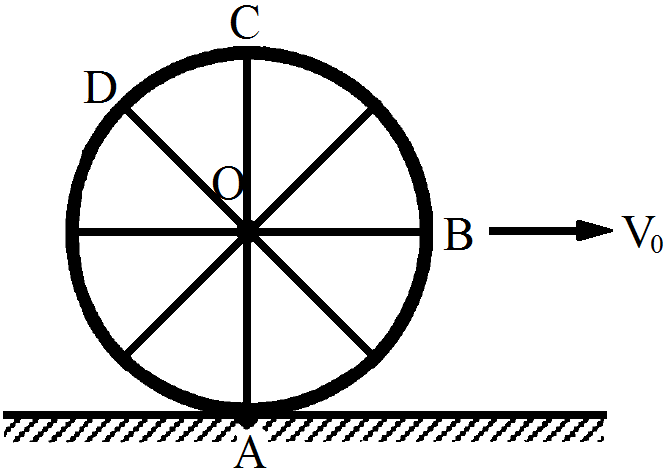
Consider a wheel of a bicycle rolling on a level road at a linear speed v0:

  1. The speed of the particle A is zero.
  2. The speed of B, C and D are all equal to v0.
  3. The speed of C is 2v0.
  4. The speed of B is greater than the speed of O.

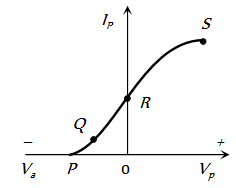
The point representing the cut off grid voltage on the mutual characteristic of triode is


(a) S 

(b) R

(c) O 

(d) P

Two metal plates having charges Q, -Q face each other at some separation and are dipped into an oil tank. If the oil is pumped out, the electric field between the plates will:
  1. Increase.
  2. Decrease.
  3. Remain the same.
  4. Become zero.

1 Curie is equal to

(a) 3  disintegrations/sec

(b) 3.7   disintegrations/sec

(c) 5 disintegrations/sec

(d) 3.7  disintegrations/sec

Mark out the correct options.