MCQ
Two identical p-ri junctions may be connected in series with a battery in three ways (figure). The potential difference across the two p-n. junctions are equal in:
  • A
    Circuit 1 and circuit 2.
  • B
    Circuit 2 and circuit 3.
  • C
    Circuit 3 and circuit 1.
  • D
    Circuit 1 only.

Answer

  1. Circuit 2 and circuit 3.

Explanation:

In circuit 1, one diode is forward biassed and the other diode is reverse biassed. The forward-biassed diode offers zero resistance (ideally) to the current flow, so it can be replaced by a short circuit. The voltage drop across the first diode will be zero. The second diode is reverse biassed, so it can be replaced by an open circuit; hence, the voltage drop across this diode will be maximum.

In circuit 2, both the diodes are forward biassed, so they can be replaced by short circuits; hence, the voltage drop across both of them will be minimum and equal.

In circuit 3, both the diodes are reverse biassed, so both can be replaced by open circuits; hence, the voltage drop across both of them will be maximum and equal.

Need a full question paper?

Generate a complete, print-ready paper with questions like this in minutes — across 16+ boards, with answer keys.

Start Generating Free

Similar questions

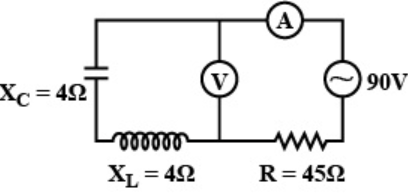
The reading of voltmeter and ammeter in the following figure will respectively be:
Image

A transistor is used in common emitter mode as an amplifier. Then

(a) The base-emitter junction is forward biased

(b) The base-emitter junction is reverse biased

(c) The input signal is connected in series with the voltage applied to the base-emitter junction

(d) a, c

The resistance of an incandescent lamp is

(a) Greater when switched off

(b) Smaller when switched on

(c) Greater when switched on 

(d) The same whether it is switched off or switched on

The motion of a particle is given by $\text{x = A}\sin\omega\text{t+B}\cos\omega\text{t}.$ The motion of the particle is:
  1. Not simple harmonic.
  2. Simple harmonic with amplitude A + B.
  3. Simple harmonic with amplitude $\frac{\text{(A}+\text{B)}}{2}.$
  4. Simple harmonic with amplitude $\sqrt{(\text{A}^2+\text{B}^2)}.$

A metallic block carrying current I is subjected to a uniform magnetic induction  as shown in the figure. The moving charges experience a force  given by ........... which results in the lowering of the potential of the face ........ Assume the speed of the carriers to be v

(a) eVB, ABCD

(b) eVB, EFGH

(c) -eVB, ABCD

(d) -eVB, EFGH

X-ray beam can be deflected:

The phase difference between incident wave and reflected wave is 180° when light ray

(a) Enters into glass from air

(b) Enters into air from glass

(c) Enters into glass from diamond

(d)  Enters into water from glass

At neutral temperature, the thermoelectric power   has the value

(a) Zero  

(b) Maximum but negative

(c) Maximum but positive

(d) Minimum but positive

Power factor of LCR circuit in resonance is:
The natural frequency of an LC - circuit is 1,25,000 cycles per second. Then the capacitor C is replaced by another capacitor with a dielectric medium of dielectric constant k. In this case, the frequency decreases by 25kHz. The value of k is: