MCQ
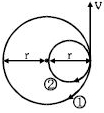
Two ions have equal masses but one is singly ionized and second is doubly ionized. They are projected from the same place in a uniform transverse magnetic field with same velocity then:
$(a)$ Both ions will go along circles of equal radii
$(b)$ The radius of circle described by the single ionized charge is double of radius of circle described by doubly ionized charge
$(c)$ Both circle do not touches to each other
$(d)$ Both circle touches to each other
  • A
    $a, c$
  • $b, d$
  • C
    $b, c$
  • D
    $a, d$

Answer

Correct option: B.
$b, d$
b
$\mathrm{r}=\frac{\mathrm{mv}}{\mathrm{qB}} \propto \frac{1}{\mathrm{q}}(\mathrm{m}, \mathrm{v}, \mathrm{B} \text { same })$

$\frac{\mathrm{r}_{1}}{\mathrm{r}_{2}}=\frac{2 \mathrm{q}}{\mathrm{q}} \Rightarrow \mathrm{r}_{1}=2 \mathrm{r}_{2}$

Need a full question paper?

Generate a complete, print-ready paper with questions like this in minutes — across 16+ boards, with answer keys.

Start Generating Free

Similar questions

Match List $− I$ (Event) with List $−II $ (Order of the time interval for happening of the event) and select the correct option from the options given below the lists
List $- I$ List $- II$
$(1)$ Rotation period of earth $(i)$ $10^5\, s$
$(2)$ Revolution period of earth $(ii)$ $10^7\, s$
$(3)$ Period of light wave $(iii)$ $10^{-15}\, s$
$(4)$ Period of sound wave $(iv)$ $10^{-3}\, s$
If energy of electron in ground state is $-13.6$ then find out speed of electron in fourth orbit of $H-$atom
A steady current $I$ goes through a wire loop $\mathrm{PQR}$ having shape of a right angle triangle with $\mathrm{PQ}=3 x, \mathrm{PR}=4 x$ and $\mathrm{QR}=5 x$. If the magnitude of the magnetic field at $\mathrm{P}$ due to this loop is $k\left(\frac{\mu_0 I}{48 \pi x}\right)$, find the value of $k$.
An electric dipole is placed at the centre of a sphere then:
In H -atom the radius of electron's first orbit in A will be :
Assertion : Neutrons penetrate matter more readily as compared to protons.
Reason : Neutrons are slightly more massive than protons.
Radioactive element decays to form a stable nuclide, then the rate of decay of reactant is
A lensmaker has to design an achromatic combination of effective power $- 0 .5D$.  The two types of glasses to be used  (say $A$. and $B$) has dispersive powers in the ratio ${\omega _A}:{\omega _B} = 3:5$ Then the lens made rom glass $A$ will have focal length.......$cm$
$A$ concave spherical refracting surface separates two media glass and air $(\mu_{glass} = 1.5)$. If the image is to be real at what minimum distance $u$ should the object be placed in glass if $R$ is the radius of curvature?
Carbon, silicon and germanium have four valence electrons each. At room temperature which one of the following statements is most appropriate ?