Question
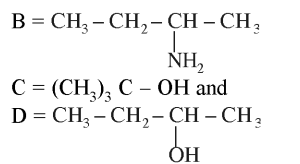
Two isomeric compounds $(A$ and $B)$ have $\ce{ C_4H_{11}N}$ molecular formula react with $\ce{HNO_2}$ and forms compounds $(C)$ and $(D). C$  is hardly oxidised but it reacts immediately with Lucas reagent whereas $D$ reacts with Lucas reagent in $5$ minutes and it also gives haloform reaction. Identify $\ce{A, B, C}$ and $\ce{D}$.
Answer

Image
$A$ and $B$ are primary amines, which react $\ce{HNO_2}$ and forms corresponding alcohols, $C$ is a tertiary alcohol which is hardly oxidised and it reacts immediately with Lucas reagent and $D$ is a secondary alcohols,
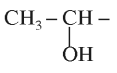
hence it reacts with Lucas reagent in $5$ minutes and due toImagegroup it gives haloform reaction.

Need a full question paper?

Generate a complete, print-ready paper with questions like this in minutes — across 16+ boards, with answer keys.

Start Generating Free

Similar questions

The decomposition of dimethyl ether leads to the formation of CH4, H2 and CO and the reaction rate is given by 
Rate $= k \left[ CH _3 OCH _3\right]^{3 / 2}$ 
The rate of reaction is followed by increase in pressure in a closed vessel, so the rate can also be expressed in terms of the partial pressure of dimethyl ether, i.e.,
Rate $= k \left( p _{ CH _3 OCH _3}\right)^{3 / 2}$
If the pressure is measured in bar and time in minutes, then what are the units of rate and rate constants?
Unlike dry cell, the mercury cell has a constant cell potential throughout its useful life. Why?
Why do gases always tend to be less soluble in liquids as the temperature is raised?
Calculate the half$-$life of a first order reaction from their rate constants given below:
  1. $200 s^{–1}$
  2. $2 min^{–1}$
  3. $4$ years$^{–1}$
What happens when surcose is heated with dilute $H _2 SO _4$ or dilute HCl ?
What do you mean by point defect in a crystal?
Find the oxidation number of Cu in the complex ion: $[Cu(NH_{3})_{4}]^{2+}$
Using IUPAC norms write the formulae of the following:
(a) Tetrahydroxozincate(II)
(b) Potassium tetrachloridopadauate(II)
(c) Diaminedichloridoplatinum(II)
(d) Hexaammineplatinum (IV)
(e) Potassium tetracyanonickelate(II)
(f) Tetrabromidocuprate(II)
(g) Pentaamminenitrito-o-cobalt(III)
(h) Pentaamminenitrito-N-cobalt (III)
During nuclear explosion, one of the products is $^{90}Sr$ with half$-$life of $28.1$ years. If $1\mu g$ of $^{90}Sr$ was absorbed in the bones of a newly born baby instead of calcium, how much of it will remain after $10$ years and $60$ years if it is not lost metabolically.
Which reference electrode is used to measure the electrode potential of other electrodes?