Question
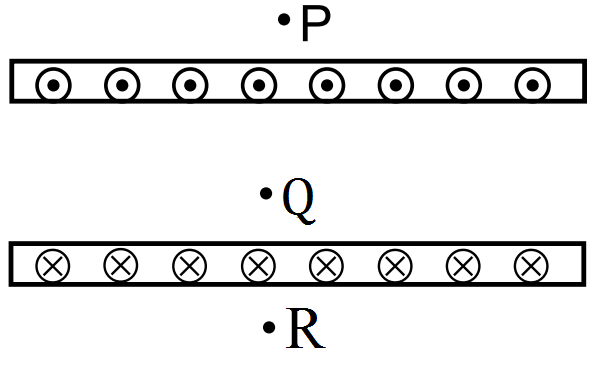
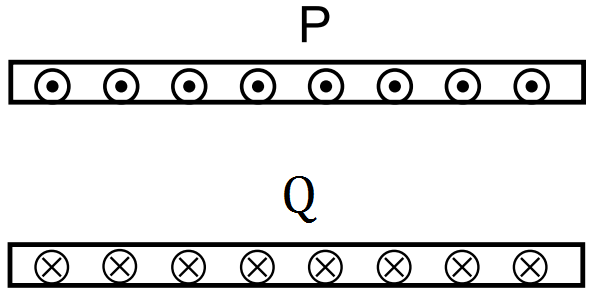
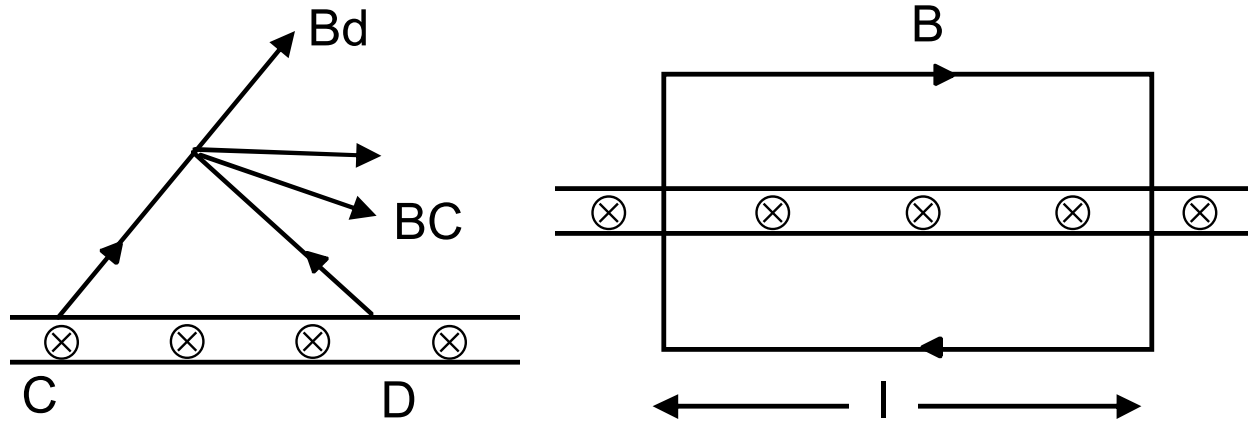
Two large metal sheets carry surface currents as shown in figure. The current through a strip of width dl is Kdl where K is a constant. Find the magnetic field at the points P, Q and R.
Answer


At point P, i = 0, Thus B = 0

At point R, i = 0, B = 0

At point $\theta,$

Applying ampere’s rule to the above rectangle
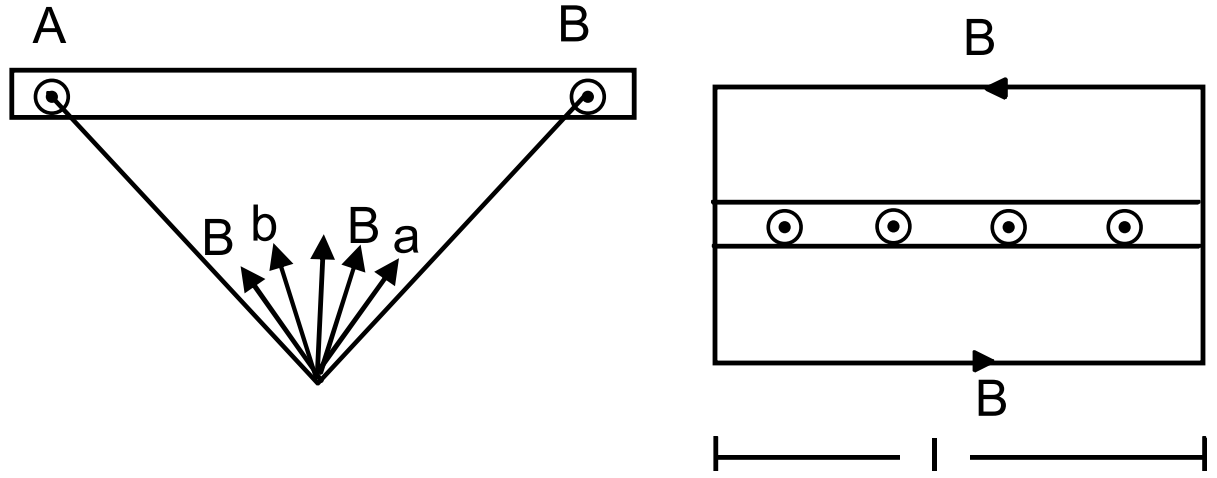
$\text{B}\times2\text{l}=\mu_0\text{K}_0\int\limits_\text{o}^\text{l}\text{dl}$

$\text{B}\times2\text{l}=\mu_0\text{Kl}\Rightarrow\text{B}=\frac{\mu_0\text{K}}{2}$

$\text{B}\times2\text{l}=\mu_0\text{K}_0\int\limits_\text{o}^\text{l}\text{dl}$

$\text{B}\times2\text{l}=\mu_0\text{Kl}\Rightarrow\text{B}=\frac{\mu_0\text{K}}{2}$

Since the $\overrightarrow{\text{B}}$ due to the 2 stripes are along the same direction, thus.
$\text{B}_\text{net}=\frac{\mu_0\text{K}}{2}+\frac{\mu_0\text{K}}{2}=\mu_0\text{k}$

Need a full question paper?

Generate a complete, print-ready paper with questions like this in minutes — across 16+ boards, with answer keys.
Start Generating Free

Similar questions

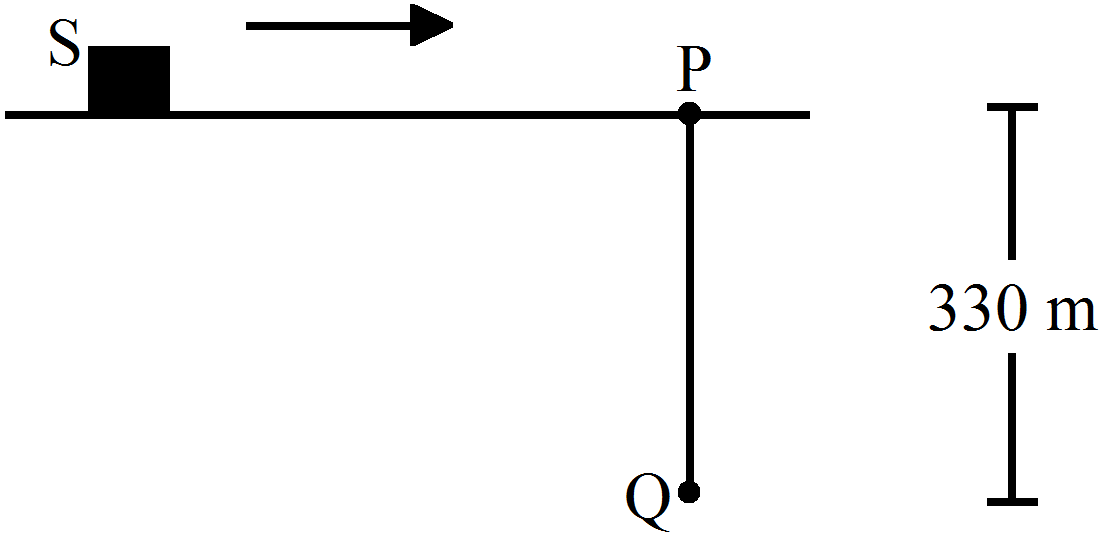
Figure, shows a source of sound moving along the X-axis at a speed of 22m/s continuously emitting a sound of frequency 2.0kHz which travels s in air at a speed of 330m/s. A listener Q stands on the Y-axis at a distance of 330 m from the origin. At t = 0, the source crosses the origin P.

  1. When does the sound emitted from the source at P reach the listener Q?
  2. What will be the frequency heard by the listener at this instant?
  3. Where will the source be at this instant?


A bullet of mass 25g is fired horizontally into a ballistic pendulum of mass 5.0kg and gets embedded in it. If the centre of the pendulum rises by a distance of 10cm, find the speed of the bullet.
A train starts from rest and moves with a constant acceleration of 2.0m/s2 for half a minute. The brakes are then applied and the train comes to rest in one minute. Find:
  1. The total distance moved by the train.
  2. The maximum speed attained by the train.
  3. The position(s) of the train at half the maximum speed.
A girl riding a bicycle along a straight road with a speed of 5m s–1 throws a stone of mass 0.5kg which has a speed of 15m s–1 with respect to the ground along her direction of motion. The mass of the girl and bicycle is 50kg. Does the speed of the bicycle change after the stone is thrown? What is the change in speed, if so?
A vessel of volume 125cm3 contains tritium $\big(\text{ }^3\text{H,t}_{\frac{1}{2}}=12.3\text{y}\big)$ at 500 kPa and 300K. Calculate the activity of the gas.
Let us take the position of mass when the spring is unstretched as $x=0$ and the direction from left to right as the positive direction of x -axis. Given x as a function of time t for the oscillating mass, if at the moment we start the stopwatch $(t=0)$, the mass is
i. at the mean position,
ii. at the maximum stretched position and
iii. at the maximum compressed position.
In what way do these functions for SHM differ from each other, in frequency, in amplitude or the initial phase?
Consider a one-dimensional motion of a particle with total energy E. There are four regions A, B, C and D in which the relation between potential energy V, kinetic energy (K) and total energy E is as given below:
Region A : V > E
Region B : V < E
Region C : K > E
Region D : V > K
State with reason in each case whether a particle can be found in the given region or not.
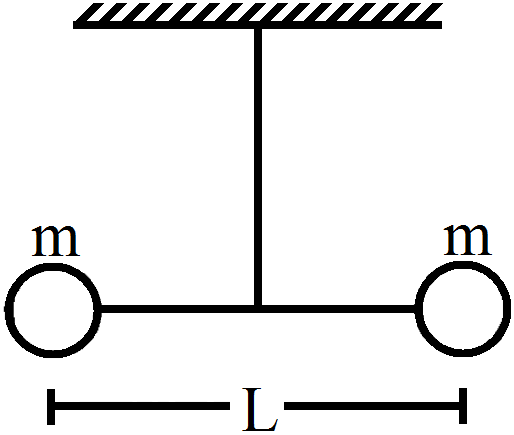
Two small balls, each of mass m are connected by a light rigid rod of length L. The system is suspended from its centre by a thin wire of torsional constant k. The rod is rotated about the wire through an angle $\theta_0$ and released. Find the tension in the rod' as the system passes through the mean position.

An object starts from rest and covers a total distance X in the following manner: It first has a uniform acceleration a1 for some time t1, moves with the speed acquired at the end of t1 for some distance and is then given a uniform retardation a2 so that it is again at rest at the end of the journey. Show that the journey is covered in least time if the body is accelerated for a time of $\Big[\frac{2\text{X a}_2}{\text{a}_1(\text{a}_1+\text{a}_2)}\Big]^{\frac{1}{2}}$ and this minimum time is $\Bigg[2\text{X}\Big(\frac{1}{\text{a}_1}+\frac{1}{\text{a}_2}\Big)\Bigg]^{\frac{1}{2}}.$
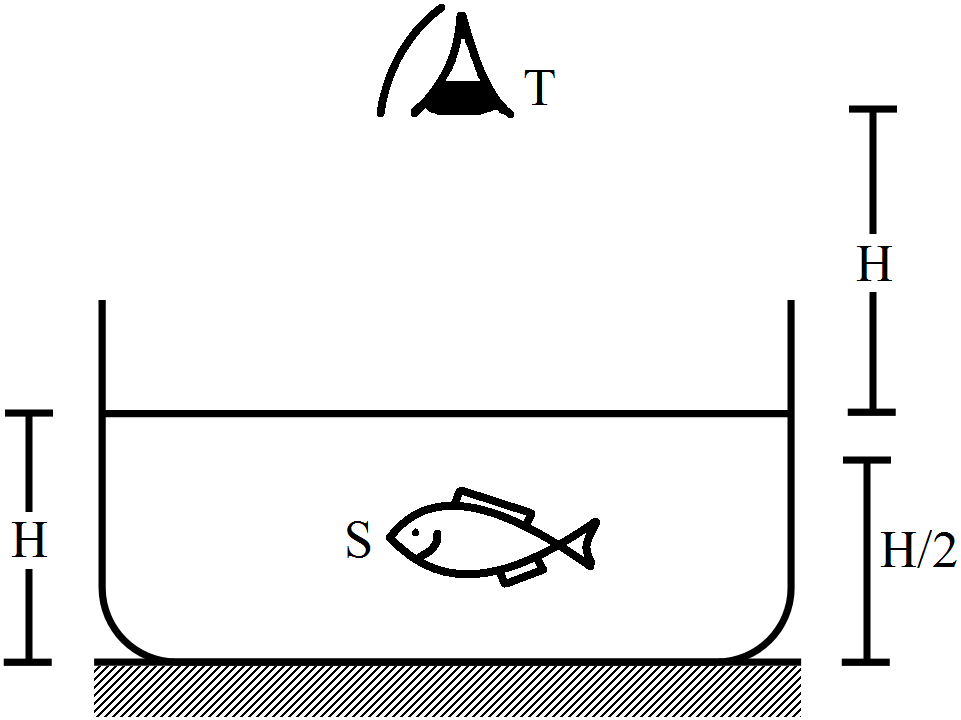
Consider the situation in figure. The bottom of the pot is a reflecting plane mirror, S is a small fish and T is a human eye. Refractive index of water is.
  1. At what distance(s) from itself will the fish see the image(s) of the eye?
  2. At what distance(s) from itself will the eye see the image(s) of the fish.