Question
Two large, thin metal plates are parallel and close to each other. On their inner faces, the plates have surface charge densities of opposite signs and of magnitude $17.0 \times 10^{-22} C / m ^2$. What is E: (a) in the outer region of the first plate, (b) in the outer re-gion of the second plate, and (c) between the plates?
Answer

Given :
$\sigma=17 \cdot 0 \times 10^{-22} C / m ^2$
Electric field produced due to layer of charge
$E =\frac{\sigma}{2 \in_0}$
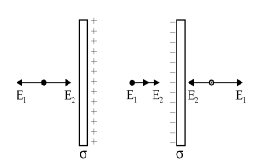
Image

If the electric field due to the positive charge layer is E1 end ,the electric field due to the negative charge layer is E2 then (a) and (b) Electric field at the outer points of the plates
$E=E_1-E_2$
or$E=\frac{\sigma}{2 \in_0}-\frac{\sigma}{2 \in_0}=0$
(c)$E=\frac{\sigma}{2 \in_0}+\frac{\sigma}{2 \in_0}=\frac{\sigma}{\in_0}$
[From positive to negative plate]
On putting values $E =\frac{17 \times 10^{-}}{8.85 \times 10^{-12}}$
$=1.92 \times 10^{-10} N / C$

Need a full question paper?

Generate a complete, print-ready paper with questions like this in minutes — across 16+ boards, with answer keys.

Start Generating Free

Similar questions

For the $L - C - R$ series $AC$ circuit derive the phase relationship between instantaneous current and voltage, using the phasor diagram.
Out of the two magnetic materials, 'A' has relative permeability slightly greater than unity while oB' has less than unity. Identify the nature of the materials 'A' and 'B'. Will their susceptibilities be positive or negative?
Write the equation of average power for $L - C - R$ series $AC$ circuit and discuss its special cases.
Three capacitors each of capacitance 9 pF are connected in series.
(a) What is the total capacitance of the combination?
(b) What is the potential difference across each capacitor if the combination is connected to a 120 V supply? S

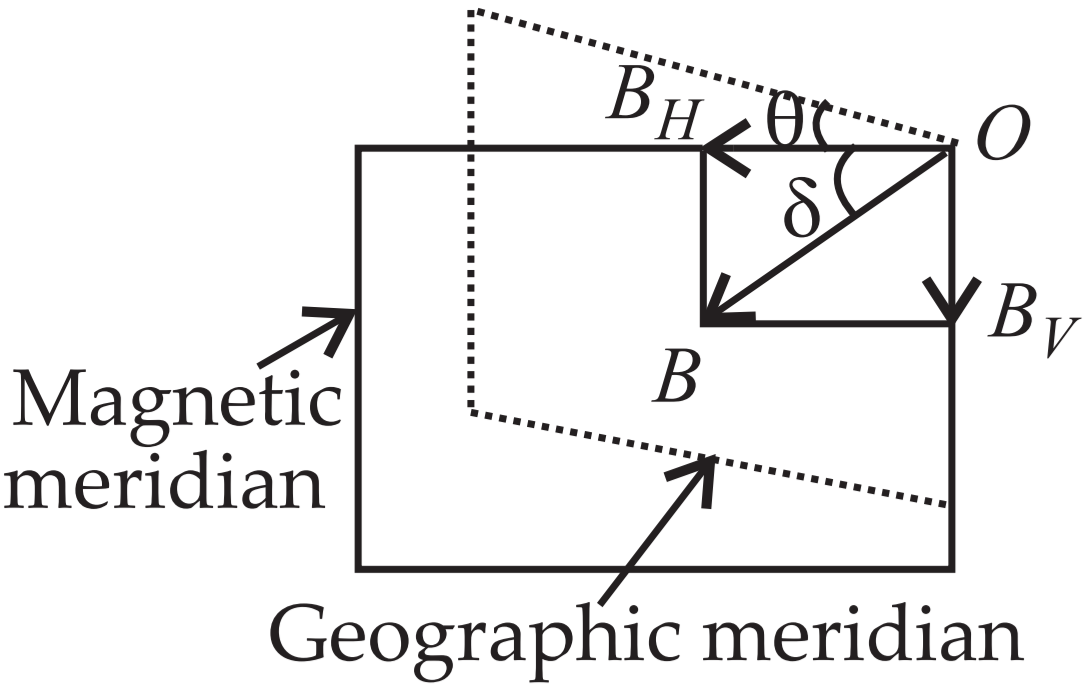
'Tile earth's magnetic field at a point on its surface is usually characterised by three quantities: (a) declination (bl inclination or dip and (cl horizontal component of the field. These are known as the elements of the earth's magnetic field. At a place, angle between geographic meridian and magnetic meridian is defined as magnetic declination, whereas angle made by the earth's magnetic field with the horizontal in magnetic meridian is known as magnetic dip.
  1. In a certain place, the horizontal component of magnetic field is $\frac{1}{\sqrt{3}}$ times the vertical component. 'Tile angle of dip at this place is:
  1. $\text{Zero}$
  2. $\frac{\pi}{3}$
  3. $\frac{\pi}{2}$
  4. $\frac{\pi}{6}$
  1. The angle between the true geographic north and the north shown by a compass needle is called as:
  1. Inclination.
  2. Magnetic declination.
  3. Angle of meridian.
  4. Magnetic pole.
  1. Tile angles of dip at the poles and the equator respectively are
  1. 30º, 30º
  2. 0º, 90º
  3. 45º, 90º
  4. 90º, 0º 
  1. A compass needle which is allowed to move in a horizontal plane is taken to a geomagnetic pole. It
  1. Will become rigid showing no movement.
  2. Will stay in any position.
  3. Will stay in north-south direction only.
  4. Will stay in east-west direction only. 
  1. Select the correct statement from the following.
  1. The magnetic dip is zero at the centre of the earth.
  2. Magnetic dip decreases as we move away from the equator towards the magnetic pole.
  3. Magnetic dip increases as we move away from the equator towards the magnetic pole.
  4. Magnetic dip does not vary from place to place. 
A uniform magnetic field of $1.5 T$ exists in a cylindrical region of radius $10.0 \ cm,$ its direction parallel to the axis along east to west. $A$ wire carrying current of $7.0 A $ in the north to south direction passes through this region. What is the magnitude and direction of the force on the wire if,
  1. The wire intersects the axis,
  2. The wire is turned from $N-S$ to northeast $-$ northwest direction,
  3. The wire in the $N-S$ direction is lowered from the axis by a distance of $6.0 \ cm$?
A metal rod is placed along the axis of a solenoid carrying a high-freqμency alternating current. It is found that the rod gets heated. Explain why the rod gets heated.
Explain the refraction by an equilateral prism and derive the formula $\delta=i+e- A$ in case of triangular prism of glass.
At room temperature, most of the $H-$ atoms are in ground state. When an atom receives some energy $($i.e., by electron collisions$),$ the atom may acquire sufficient energy to raise electron to higher energy state. In this condition, the atom is said to be in excited state. From the excited state, the electron can fall back to a state of lower energy emitting a photon equal to the energy difference of the orbit.

In a mixture of $He-He$ gas $(He^+$ is singleionized $He$ atom$)$.
$​​​​​​​H-$ atoms and $He^+$ ions are excited to their respective first excited states.
Subsequently $, H-$atoms transfer their total excitation energy to $He^+$ ions $($by collisions$)$
  1. The quantum number n of the state finally populated in $He^+$ ions is.
  1. $2$
  2. $3$
  3. $4$
  4. $5$
  1. The wavelength of light emitted in the visible region by $He^+$ ions after collisions with $H-$ atoms is.
  1. $6.5 \times 10^{-7} m$
  2. $5.6 \times 10^{-7} m$
  3. $4.8 \times 10^{-7} m$
  4. $4.0 \times 10^{-7} m$
  1. The ratio of kinetic energy of the electrons for the $H-$ atoms to that of $He^+$ ion for $n = 2$ is.
  1. $\frac{1}{4}$
  2. $\frac{1}{2}$
  3. $1$
  4. $2$
  1. The radius of the ground state orbit of $H-$ atoms is.
  1. $\frac{\epsilon_0}{\text{h}\pi\text{me}^2}$
  2. $\frac{\text{h}^2\epsilon_0}{\pi\text{me}^2}$
  3. $\frac{\pi\text{me}^2}{\text{h}}$
  4. $\frac{2\pi\text{h}\epsilon_0}{\text{me}^2}$
  1. Angular momentum of an electron in $H-$ atom in first excited state is.
  1. $\frac{\text{h}}{\pi}$
  2. $\frac{\text{h}}{2\pi}$
  3. $\frac{2\pi}{\text{h}}$
  4. $\frac{\pi}{\text{h}}$
By mistake, an eye surgeon puts a concave lens in place of the lens in the eye after a cataract operation. Will the patient be able to see clearly any object placed at any distance?